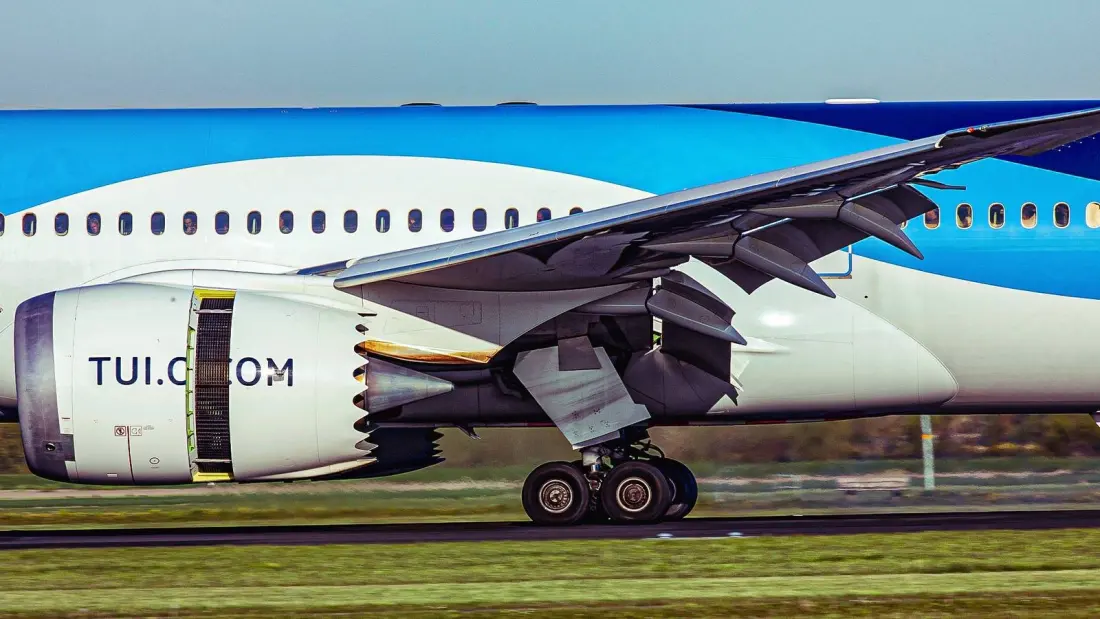
Boeing's 787-10 and Airbus's A350-900 look like close cousins from an airport window seat — similar size, similar composite-heavy airframes, similar long-haul missions. But look under the skin, specifically at the landing gear, and you find two companies that solved the same problems in completely different ways.
The headline difference is the 787-10's semi-levered main gear. Because the -10 is a double stretch of the Dreamliner family, running 224 feet (68.28m) end to end, its tail sits a long way behind the wheels. Rotate too steeply and you risk a tail strike. Boeing's fix: a hydraulic actuator limits how far the wheel bogie tilts during takeoff, effectively pushing the strut up and lifting the fuselage higher off the runway. Airbus sidestepped the problem entirely — the A350-900 was a clean-sheet design about five feet shorter, so engineers simply set the gear height correctly from day one and kept a conventional center-pivot bogie.
Weight tells another story. The A350-900's oleo-pneumatic (nitrogen-and-oil) shock struts handle a maximum landing weight over 300 tons, so they're big, heavy-duty cylinders. The lighter 787-10 lands at up to 205 tons, letting Boeing reuse the compact strut from the smaller 787-8 and 787-9 — and, in an industry first, forge the inner cylinder from solid titanium instead of steel, with a carbon-fiber drag brace from Safran shaving off hundreds of pounds. Airbus, needing stiffness for its heavier airframe, stuck with ultra-high-strength steel braces and reserved titanium for axles and high-stress pivot joints; its composite use on the gear is limited to doors and fairings.
Ground steering splits along similar philosophical lines. Both jets are essentially steering-by-wire — the A350 converts sidestick and tiller inputs into digital commands for the hydraulic actuators, with the nose wheel swivelling up to 72 degrees and automatic crosswind corrections. Boeing's Liebherr remote electronic unit does much the same, but reportedly gives pilots a more tactile, analog-feeling response through the tiller.
Brakes are where Boeing went boldest. True to its 'More Electric Aircraft' philosophy, the 787 ditches hydraulic lines, valves and fluid entirely: electric motors press the carbon brake pads together, and software tracks brake wear automatically. The A350-900, over 20 tons heavier and needing to absorb more landing energy, keeps conventional hydraulic actuation but adds electric fans that blast cooling air through the brake discs right after touchdown — helping airports turn the aircraft around faster.
Why should a traveller care? For aviation fans, it's a neat way to tell these two jets apart — the semi-levered gear and all-electric brakes are genuine 78-7 quirks, while the A350's fan-cooled brakes and fully digital steering reflect Airbus's later, cleaner start. And for passengers, both approaches feed directly into what you experience on the ground: smoother landings, tighter taxi turns and quicker turnarounds between flights. Full marks to Simple Flying for the detailed technical comparison.