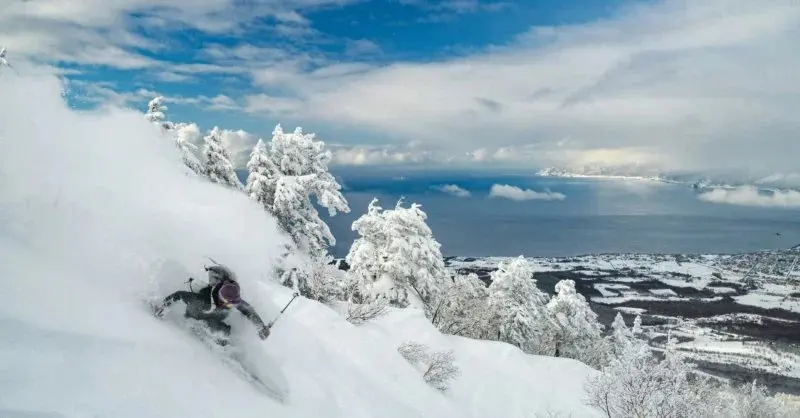
Japan's snow has earned its own nickname — 'Japow' — and once you understand why, it's hard to book an Alpine trip the same way again. Siberian winds sweep across the Sea of Japan, pick up moisture, then slam into the country's mountain ranges and dump enormous quantities of snow with a moisture content as low as four percent. The result: dry, feather-light powder by the metre, with some areas recording over 60 feet of snow in a season. Add slope-side bowls of ramen and a soak in an onsen afterwards, and the Alpine formula starts looking a little tired.
There are more than 500 resorts across the country, many absurdly easy to reach — a bullet train from Tokyo puts you on the slopes in under 30 minutes.
**Hokkaido: the powder capital.** Niseko is the headline act, with four interlinked resorts on one mountain (Grand Hirafu, Hanazono, Niseko Village and Annupuri), backcountry access and floodlit night skiing that runs into the evening. It's the livelier option too: Bar Gyu+ hides behind a vintage refrigerator door and pours serious Japanese whisky, while Hertzz hosts vinyl DJs in a converted ski shop. For something quieter, specialists point to Kiroro, whose terrain spans the Asari and Nagamine peaks and pairs well with a side trip to Otaru for seafood and its historic canal district. Heli-skiing is tightly restricted but possible — Hokkaido Backcountry Club runs six-run days on Shiribetsu-Dake for confident experts.
**Nagano: the 'Roof of Japan'.** Home to 15 of the country's 23 peaks over roughly 10,000 ft, Nagano hosted the 1998 Winter Olympics (notably, the article says 1988 — the alpine speed events ran at Hakuba Happo-One, where the Olympic downhill course is still open to intermediate and advanced skiers). Shiga Kogen is Japan's largest linked ski area: 18 zones and around 70 lifts on a single pass. Nozawa Onsen mixes about 50km of runs with a centuries-old village of 13 Edo-era public bathhouses, plus the Dosojin Fire Festival every January 15.
**Tohoku: the quiet corner.** Northern Honshu draws experienced riders and far smaller crowds, with a more authentically Japanese feel. Guided 'ski safaris' here take in the surreal 'Snow Monster' trees, sculpted by wind and freezing fog.
**Timing matters.** Season runs roughly mid-December to April, with Hokkaido opening as early as late November. Early season means quiet slopes but patchy cover; January and February deliver the deep, consistent Japow at its peak; March and April bring sunshine, milder weather and thinner crowds — ideal for beginners, though powder gets less reliable. April is also when the Tateyama Kurobe Alpine Route reveals its towering 65-ft snow walls.
Non-skiers aren't left out: operators can arrange a four-and-a-half-hour snowshoe hike from the Kita-Yatsugatake ropeway up Mt Shimagare, with views over the Japanese Alps on clear days.
For anyone after deep powder, hot springs and a food scene that beats a generic mountain buffet, Japan is the trip.