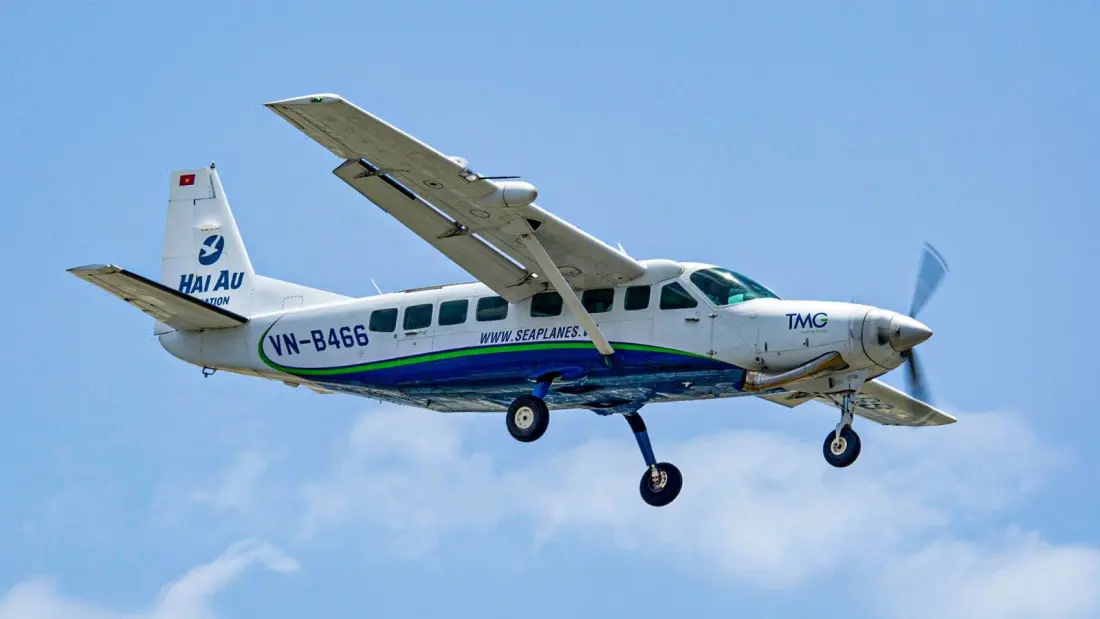
If you've ever hop-scotched between islands in the Maldives or landed on a dirt strip in the African bush, odds are you flew in a Cessna Grand Caravan EX. It's the world's most prolific utility turboprop — and it cruises at just 185 knots, roughly 213 mph. That sounds modest next to a jet, but the number is a deliberate design choice, not a limitation.
The current EX version runs an 867-shaft-horsepower Pratt & Whitney PT6A-140, a big step up from the 675-shp engine in older Caravans. The extra power isn't about speed; it keeps climbs strong and cruise stable even when the plane is full at high-altitude or hot-weather strips. Most commercial aircraft carry a ventral cargo pod under the belly for bags and freight, which costs about 10 knots — a clean airframe can nudge toward 195 KTAS, but operators almost always take the storage over the speed.
Where the Caravan earns its keep is off tarmac. Its high-wing, fixed-gear design needs only 1,399 feet of ground roll at maximum takeoff weight, and it can land on gravel, grass, or mud with ease. Pilots typically approach between 75 and 85 knots, letting them drop steeply into jungle clearings or mountain strips that would ground faster aircraft. That trade-off — dragging fixed gear and a thick lifting wing everywhere it flies — is exactly why it can't cruise with faster turboprops, and why it doesn't need to.
For travellers, this matters on shorter itineraries. Practical range with a full load is around 300 to 500 nautical miles, and on hops under 45 minutes the difference between flying at 160 or 185 knots is a few minutes at most. Burn is about 55 gallons of jet fuel per hour at typical cruise, so operators often fly slower long-range profiles to save fuel in places where supply is thin. Meanwhile the Garmin G1000 NXi glass cockpit keeps single pilots on top of tricky approaches, from Alaskan valleys to savannah thunderstorms.
So next time you're crammed into a Caravan with eight other passengers and a pile of cargo, remember: the plane was never meant to be quick. It was built to get you, your bags, and half a ton of freight onto a 2,000-foot dirt strip safely, reliably, and on schedule — which is why it dominates feeder routes from humanitarian missions to island-hopping schedules, and why it's a likely testbed for hybrid and electric propulsion down the line.