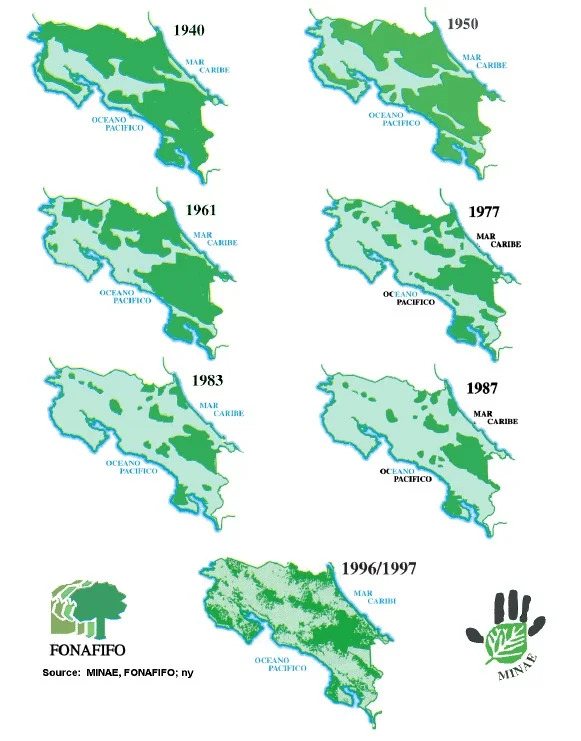
Costa Rica has more than doubled its forest cover in a single generation, going from one of the most deforested countries in Latin America to a global poster child for recovery. The numbers tell the story: roughly 75% of the country was forested in the 1940s, then decades of logging, cattle ranching and agricultural expansion stripped it down to as little as 21-30% by the late 1980s. Today, forest cover sits at nearly 60%, with more than a quarter of the nation inside protected parks and reserves.
The collapse wasn't accidental. Government incentives actually encouraged it — cheap credit for cattle, subsidies for clearing pasture, and rising global demand for beef. By the time the crisis was undeniable, the tropical moist zones most suitable for farming had taken the heaviest losses.
The turnaround came through policy that made trees worth more standing than felled. In the late 1980s and 1990s, Costa Rica banned deforestation without government approval, rewrote its legal framework to value intact forest, and launched the Payment for Environmental Services programme, run by FONAFIFO and funded by a tax on fossil fuels. Landowners literally get paid to preserve or regenerate forest, and thousands of families have benefited. The country also expanded its network of protected areas.
What made the recovery stick, though, is the part travellers know best: ecotourism. When visitors pay to walk canopy bridges, spot resplendent quetzals and surf beside jungle-lined beaches, local communities gain a direct financial reason to keep the forest healthy. Conservation became part of the national identity, not just a government directive. Costa Rica's incentive-driven model is now studied by policymakers worldwide.
For anyone planning a trip, this is the backdrop to everything you'll do there. The cloud forests of Monteverde, the canals of Tortuguero, the trails around Arenal — all of it exists because of this turnaround, and tourism revenue is a big part of why it continues. Choosing locally run lodges and guides keeps that loop working.