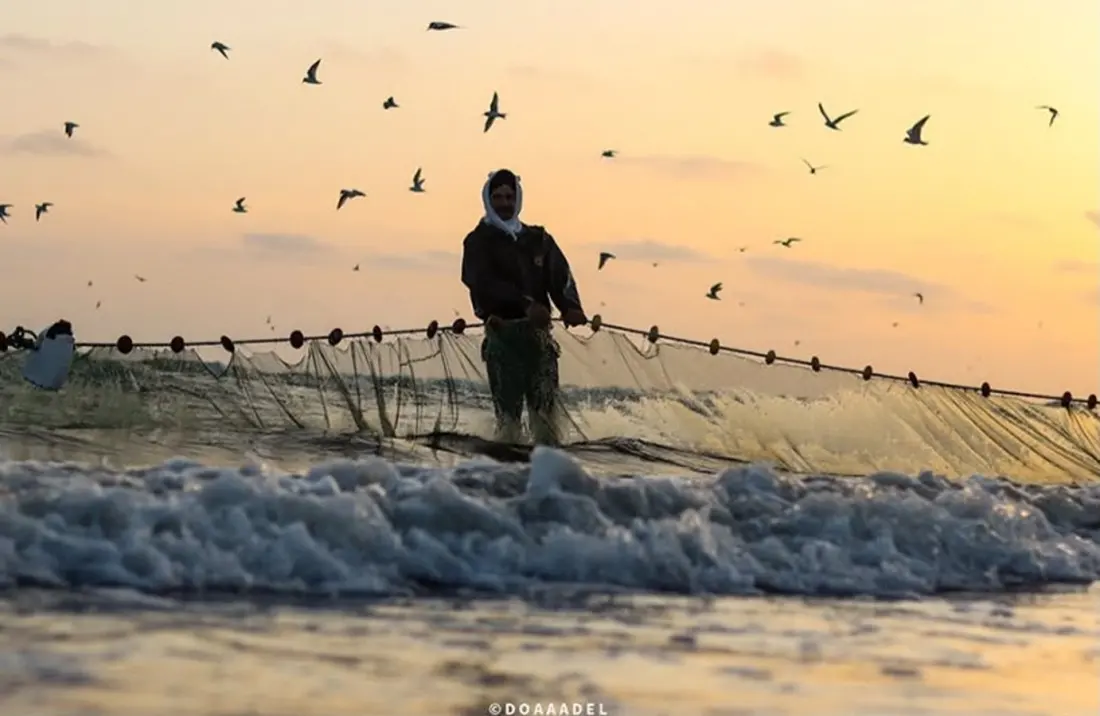
Port Said has always lived off the water. The Egyptian city sits where the Mediterranean meets the northern mouth of the Suez Canal, and its fishing culture runs deep — so deep that many families have worked the sea for generations. Now one of them is connecting that heritage to another Port Said tradition: fashion.
Moemen Sobh, who describes himself as a fisherman before an engineer, comes from a line of fishermen on one side and fashion designers on the other (his grandmother, now approaching ninety, still works). In 2022, he began spending months at the city's fishing market with just a notebook and camera, listening to fishermen describe collapsing catches. Some reported that hauls of 100 kilograms in 2017 had shrunk to around 20 today. At least twelve native species have vanished from local waters, and three oil spills hit the coast in 2022 and 2023 alone.
His response is Visenleer, a social enterprise that upcycles discarded fish skin into a textile alternative to materials like nylon. The raw supply is plentiful: Port Said's fishing market generates more than ten tonnes of fish waste every week. Backed by the Swarovski Foundation's Creatives for Our Future programme, the venture has already upcycled 60,000 fish skins and diverted 20 tonnes of ocean-bound plastic, with its first full fashion collection due in October.
The model does more than make materials. Fishermen earn roughly 30 percent more by selling waste that previously had no value, and Visenleer runs education programmes on sustainable harvesting — letting undersized fish grow so stocks recover. Fisherwomen, including fishermen's wives, handle processing of the skins. Every batch carries a Digital Product Passport tracing its origin and impact, and for every 20 square metres of fish skin sold, a tree is planted using fish waste as fertiliser — the goal is carbon negative, not merely neutral.
There's a food angle too, and it's one worth planning a trip around. Port Said ranks among Egypt's great seafood capitals, thanks to its position between Mediterranean saltwater and the brackish Lake Manzala. The local bolti (tilapia), raised in the lake's nutrient-rich waters, is prized across Egypt for a distinctly sweet flavour. Lake Manzala itself holds more than 600 islands with communities that have lived there for generations — a place even most Egyptians don't know about.
For travellers, this story reframes Port Said from a canal transit point into a working coastal city with an identity worth exploring: a seafood lunch by the Mediterranean, a walk through the fishing market, and a front-row view of how climate change and creativity collide. It's also a rare chance to witness sustainable fashion being built from the dock up — the first collection arrives this October.
Story reported by Egyptian Streets.