
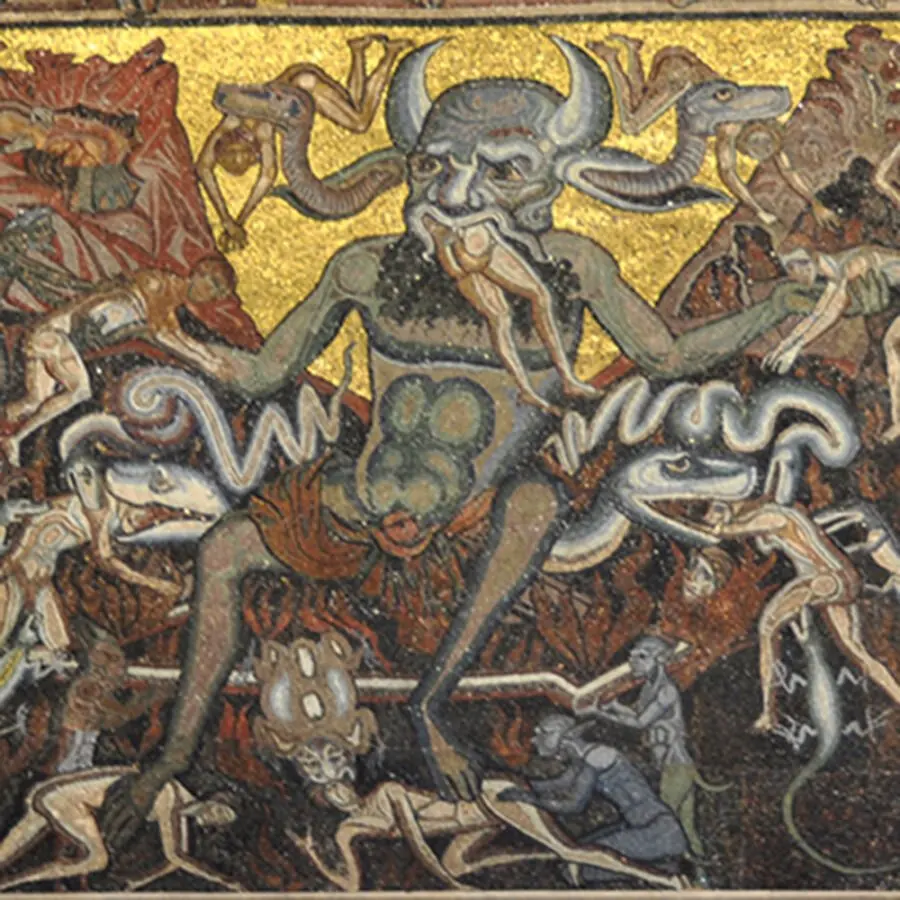
Above the baptismal font in Florence's Baptistery, a 13th-century mosaic shows the Last Judgment in unflinching detail: a horned, bull-headed monster gorging on sinners, snakes sprouting from his ears and tail, flames everywhere. Rick Steves recently used this image of medieval hell to draw a pointed comparison with modern vaccine scepticism — medieval people had no science to explain their plagues, while today's anti-vaxxers have no such excuse.
The Baptistery itself is worth a long look. It's the oldest surviving building in Florence, nearly a thousand years old, raised on Roman foundations. Most visitors queue for the famous bronze doors outside — Ghiberti's celebrated "Gates of Paradise" — but the dim, golden interior is where the medieval atmosphere survives intact. Its octagonal dome glitters with mosaics of angels and biblical scenes, and dominating them all is Christ at the Last Judgment, arms spread in the ultimate thumbs-up, thumbs-down verdict: heaven for the righteous, hell for everyone else.
What makes the hell panel remarkable is how specific it is. The Bible offers only vague pointers — dark, underground, fiery, eternal — so the anonymous mosaicists had to invent the visuals themselves. They produced something startlingly vivid for the pre-Renaissance era: the beast has defined abs, a braided beard, and a red robe that mirrors the flames; the damned twist and crouch in poses that feel genuinely anguished. This realism influenced proto-Renaissance painters like Giotto, and the building's architecture inspired Brunelleschi.
There's a direct literary link too. Shortly after the mosaic was finished, a baby named Dante Alighieri was baptised in the font directly beneath it. Art historians see that childhood view of hell echoed through his Inferno: craggy terrain, hordes of naked wretches, and a Minotaur at the centre — mirroring the bull-headed monster looming over the dome. Dante's imagery then fed centuries of European art, from Giotto and Signorelli onwards, shaping how much of the world still imagines hell. It's a remarkable chain: anonymous craftsmen working in 13th-century Florence effectively designed the underworld we picture today.
For travellers, the Baptistery is one of the most rewarding stops in Florence precisely because it's easy to overlook. You can see the doors, duck inside, and stand under the dome where both the mosaic and Dante's imagination took shape — all within a few minutes' walk of the Duomo. Standing there, you're looking at the scene that quietly inspired some of the most famous art and literature ever produced in Europe.