
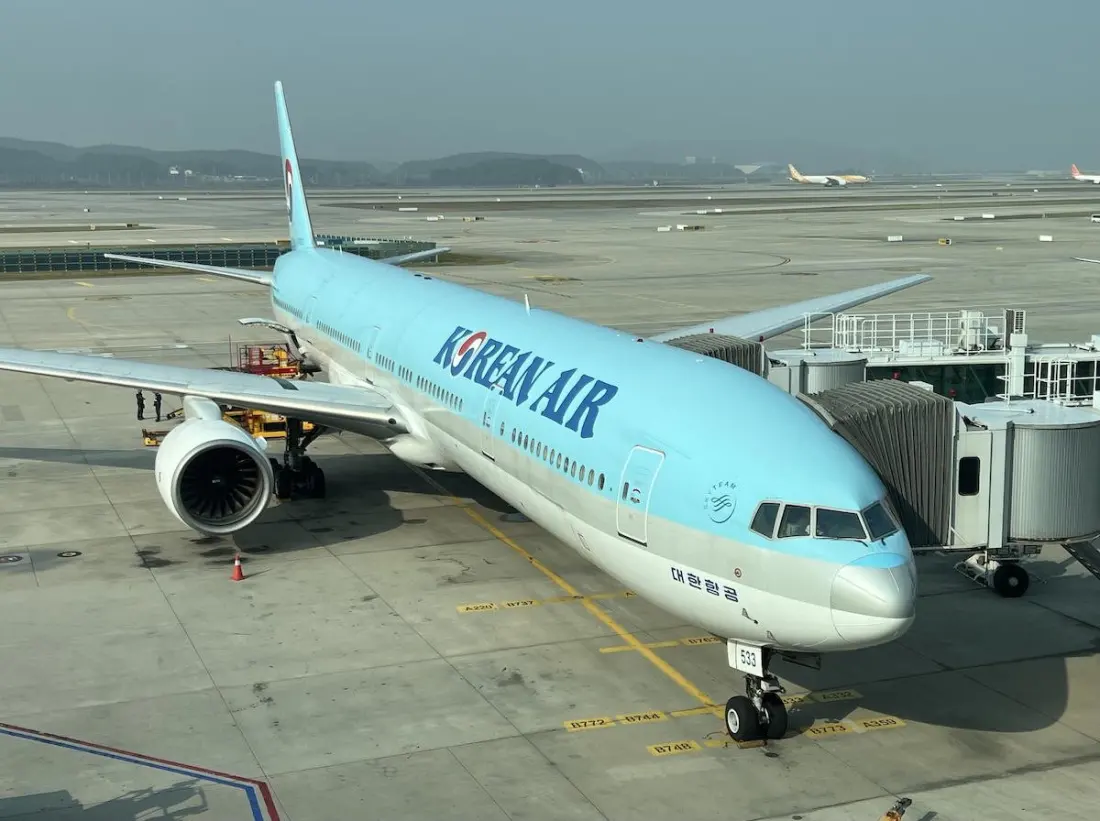
Korean Air has been one of the odd ones out among global carriers: a flagship airline from one of the world's most wired countries, whose planes largely had no inflight internet at all until 2023. That's about to change dramatically. The airline has confirmed its free Starlink Wi-Fi rollout begins on September 15, 2026, with the whole Korean Air and former Asiana fleet expected to be connected by the end of 2027.
The service debuts on four wide-body aircraft — three Airbus A350-900s and one Boeing 777-300ER — which will fly medium and long-haul routes to the Americas, Europe and Southeast Asia, plus some key short-haul sectors. Starlink's satellite broadband is fast enough for live streaming, gaming and proper on-ground-style productivity, and it will be available gate to gate. Korean Air says it's the first carrier in East Asia to offer the service. Voice and video calls are blocked to keep the cabin peaceful, which most passengers will consider a feature, not a bug.
The rollout covers more than just Korean Air. Its sister carriers — Asiana Airlines, Jin Air, Air Busan and Air Seoul — will all get free Starlink across their fleets. Asiana's brand is set to disappear in December 2026 as the merger completes, so ex-Asiana aircraft will transition to Korean Air's livery and, eventually, its internet.
The backstory is almost as interesting as the news. Korean Air only started adding Wi-Fi in 2023, and it's still on a small slice of the fleet. Back in 2016, a company executive explained why it hadn't bothered: South Korea's ground internet is so fast that the sluggish satellite Wi-Fi of the era would have disappointed passengers accustomed to cutting-edge connectivity. In other words, the airline skipped a mediocre product and waited for something worth having. Starlink's low-latency, high-speed service finally meets that bar, making the leap from zero Wi-Fi to best-in-class connectivity in the space of about four years.
For travellers, the practical takeaway is to check your aircraft type from September 2026 onwards: if you're booked on an A350-900 or 777-300ER, you're likely on one of the first connected planes, with coverage expanding steadily through 2027. It's a genuine perk on long-haul routes across the Pacific and to Europe, where a fast, free connection can turn a 12-hour flight into working hours or a streaming binge. Anyone flying the carrier's regional subsidiaries — Jin Air especially, a popular low-cost option in Asia — should benefit too as the fleet-wide install progresses.