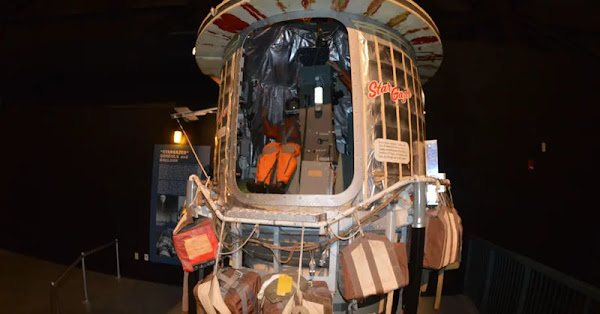
In December 1962, two men drifted to around 82,000 feet above New Mexico beneath a giant Mylar balloon, pointing a telescope at stars from a sky so dark it looked like night. It was called Project Stargazer, and it remains one of the strangest and boldest experiments in the history of astronomy — a crewed balloon turned flying observatory.
The problem it tackled was familiar to every astronomer of the era: Earth's atmosphere blurs and absorbs starlight, so even the best ground-based telescopes see a smeared universe. Scientists had already shown that instruments lifted into the stratosphere by balloon could see far more clearly. Project Stargazer, run jointly by the US Air Force, Navy, Smithsonian Institution and MIT, asked a bigger question: could a human crew up there run a telescope well enough to do serious science?
That was harder than it sounds. A gondola hanging beneath a balloon sways, spins and drifts constantly, so MIT engineers built a stabilisation system using gyroscopes, star trackers and gimbals to keep a 12.5-inch reflecting telescope locked onto distant stars. The pilot was Captain Joseph Kittinger, already famous for his record 102,800-foot parachute jump during Project Excelsior two years earlier, alongside astronomer William C. White.
On 13 December 1962, they lifted off from Holloman Air Force Base in a sealed aluminium cylinder 13 feet tall and 7 feet across, rising above more than 95 percent of the atmosphere. During a flight lasting about eighteen and a half hours, White successfully observed bright stars including Capella, Rigel and Sirius, and the mission also gathered useful data on life support and pressure suits. By any measure it worked.
Yet the timing was cruel. John Glenn had orbited Earth earlier that year, and everyone's attention — and budget — was moving to spacecraft. Three more Stargazer flights were planned but never flew. NASA's Orbiting Astronomical Observatory program followed soon after, with OAO-2, coincidentally nicknamed "Stargazer", becoming the direct ancestor of missions like Hubble.
Why should a traveller care? The Stargazer gondola survives and is on display at the National Museum of the United States Air Force in Dayton, Ohio — one of the best aviation museums anywhere, and free to enter. It's a tangible piece of the awkward, experimental era between aeroplanes and spacecraft, when the edge of space was reached by balloon. The story also has a modern echo: scientists still launch unpiloted research balloons that loiter in the stratosphere for weeks, and places like New Mexico remain centres of that quiet ballooning tradition. For anyone fascinated by space history, it's a rewarding detour.