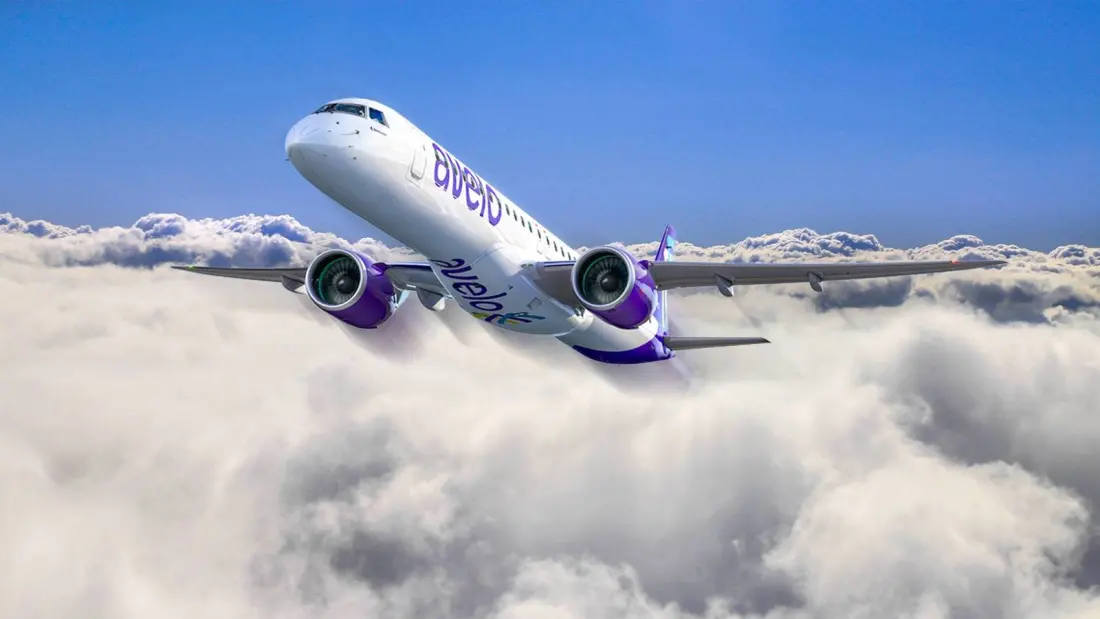
Six years after entering service, Embraer's E195-E2 finally found an American customer. On September 10, 2025, budget carrier Avelo Airlines signed a firm order for 50 of the jets, with purchase rights for 50 more — a deal worth $4.4 billion at list prices. First deliveries are due in the first half of 2027, making Avelo only the second North American operator after Canada's Porter Airlines.
The reason no US airline had touched the E2 family before comes down to contract fine print rather than the aircraft itself. American pilot union contracts include so-called scope clauses, which cap the planes regional partners can fly for mainline carriers at 76 seats and 86,000 lb maximum takeoff weight. The E195-E2 seats up to 146 — nearly double the cap — and even the smaller E175-E2 exceeds the weight limit. So Embraer has watched its next-generation regional jet languish in the world's biggest regional market, with its 190-strong E195-E2 backlog at mid-2025 going almost entirely to airlines in Europe, Asia, Africa and South America.
Avelo, though, has no regional subsidiary and flies nothing on behalf of a mainline carrier. The clause simply doesn't apply, freeing it to buy what larger rivals legally can't mix into regional operations.
Why the E2 rather than Airbus's A220? Fuel burn between the two is roughly a wash, but the Embraer is markedly more efficient than the second-hand Boeing 737-700s and -800s Avelo flies today. Timing mattered too: Airbus supply-chain bottlenecks would likely delay A220 deliveries, while a carrier that just secured its largest investment since its 2021 launch needs aircraft it can actually grow with. Then there's the cabin — a two-by-two layout with no middle seats at all, and a quieter ride than the older jets most US flyers are used to.
The deal turns Avelo into a dual-fleet operator from 2027, running the new Embraers alongside its 22 737NGs rather than replacing them. The type's short-runway performance fits the airline's model of serving smaller cities and congested airports — it runs a large base in Connecticut — and analysts see the order as a signal that Avelo intends to compete harder on both cost and network reach.
For travellers, the practical payoff is a growing fleet of no-middle-seat jets on shorter routes, potentially opening up thinner routes to smaller airports that 737s can't serve economically. The open question is whether an airline of Avelo's size can handle two fleets at once while the network scales — the first deliveries in 2027 will start to answer that.