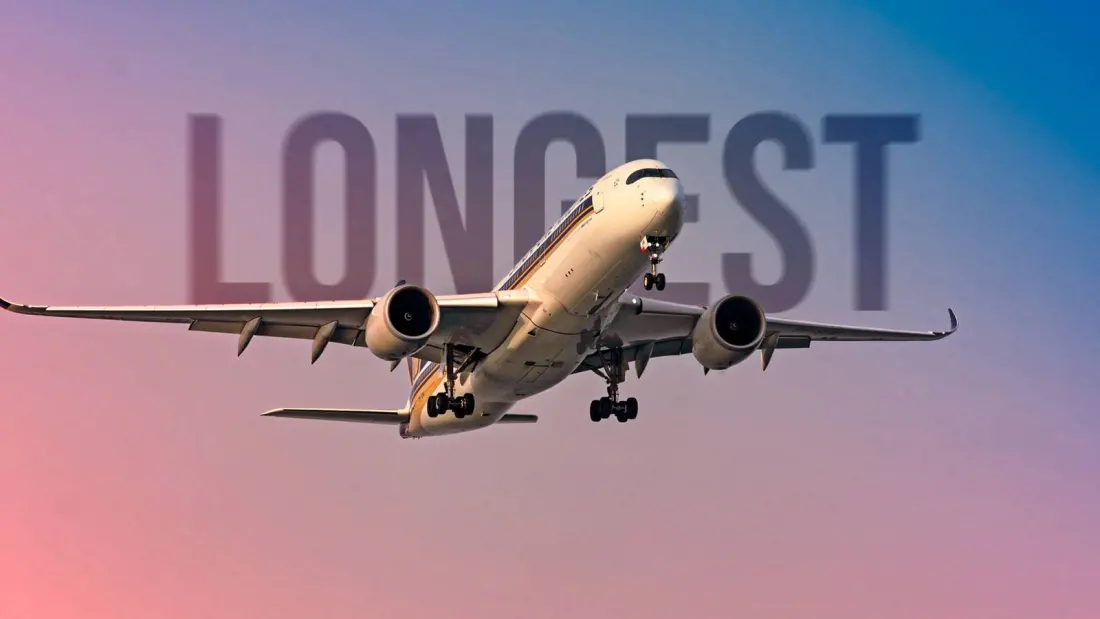
The longest nonstop commercial flight in the world isn't some novelty route — it's a twice-daily service between Singapore Changi and New York that keeps passengers airborne for close to 19 hours. Singapore Airlines has run these flights for years, and the reason they exist at all comes down to one aircraft: the Airbus A350-900ULR, an extra-long-range version of the standard jet that the airline helped launch. It can cover up to 11,160 miles (17,960 km), while the Singapore–New York sector itself runs roughly 10,300 miles (16,700 km).
The economics behind it are more interesting than the raw distance. Singapore Airlines first tried the route in 2004 with an Airbus A340-500 and gave up in 2013 because the numbers didn't work. When it relaunched in 2018 with the A350-900ULR, it deliberately fitted just 161 seats — 67 business class and 94 premium economy, with no economy cabin at all. Fewer seats means less weight and more high-paying passengers, which matters enormously when a flight burns fuel for the better part of a day. The route connects two big business markets with strong premium demand, and Changi's hub status lets the airline fill it with connecting travellers from across Asia too.
That formula is hard to copy. An ultra-long-range aircraft can't easily be used on shorter routes without wasting its expensive capability, and flights of this length leave little slack — headwinds, diversion airports, crew limits and cargo all eat into the margins. Singapore Airlines had the plane, the demand and the hub, all at once.
Now Qantas is building the next generation. Its Project Sunrise order covers 12 Airbus A350-1000ULRs, each with an extra 20,000-litre fuel tank, capable of flights beyond 10,000 miles and up to 22 hours. The first airframe flew for the first time in June 2026, delivery is expected in April 2027, and daily Sydney–London flights are set to start in October 2027, with tickets on sale from February. Sydney–New York is confirmed as the next route. Qantas has gone low-density too — 238 seats across four cabins, over 40% premium — but it's keeping an economy section and adding a wellbeing zone, with help from the University of Sydney on lighting and meal timing for a flight that can swallow almost a whole day.
For travellers, the practical upshot is simple: if you're flying between Australia and Europe or the US east coast, the days of a stopover are numbered. And if you've always wanted to try the world's longest flight, Singapore Airlines' business and premium economy cabins remain the benchmark — at least until Qantas starts selling seats in early 2027.
Credit: Simple Flying