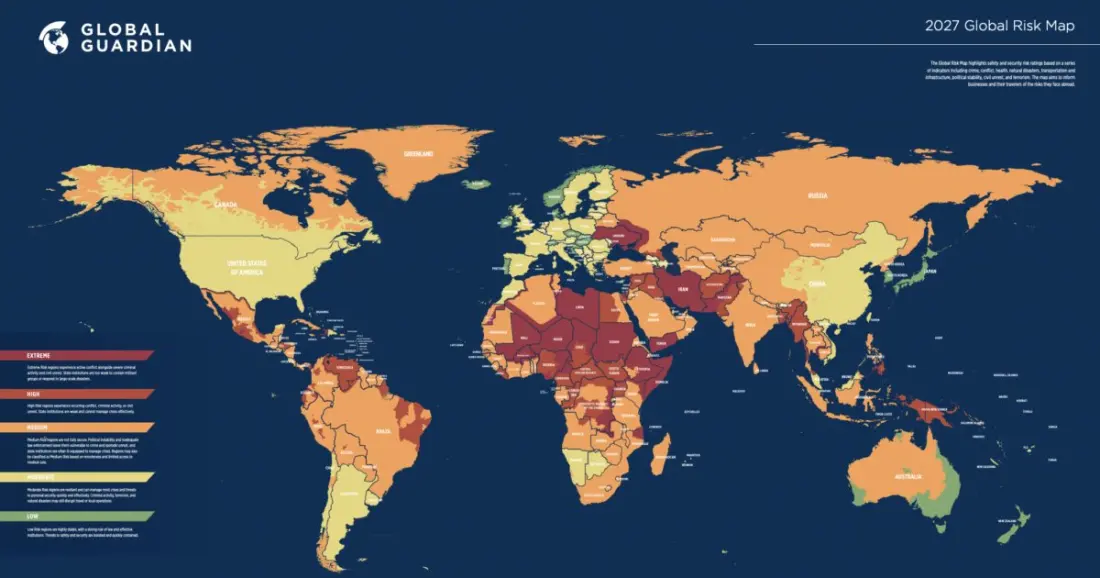
Planning travel for 2027? A fresh risk assessment suggests checking the map before booking. Global Guardian, a Virginia-based security services firm, has published its annual Global Risk Map, colour-coding every country from green (low risk) to red (extreme) based on crime, conflict, health, natural disasters, infrastructure, political stability, civil unrest, terrorism — and, unusually for this kind of report, cyberthreats.
The five-level system works much like the US State Department's travel advisories, so it's best treated as a second opinion rather than a replacement. One key nuance: more than half the countries on the map carry multiple risk levels within their borders. Mexico is the classic example — CEO Dale Buckner notes border areas and cartel-active western regions can rate very high, while Mexico City and Guadalajara sit at medium to low. In other words, national averages can mislead.
Where's red? The extreme-risk list includes Gaza, Haiti, Iran, Myanmar, Ukraine and Yemen, plus a stretch of northern and central Africa running from Mali to Somalia — places with active conflict, severe crime and governments unable to respond to disasters. The war in Iran, which began in February, has also pushed risk ratings up across the Gulf: Bahrain, Jordan, Kuwait, Qatar, the UAE and Saudi Arabia have all slipped from moderate as Houthi attacks on civilian airports increase.
The green list is reassuringly familiar for holidaymakers. Japan, New Zealand, Switzerland, Denmark, Iceland, Norway, Ireland and Portugal all qualify, along with central European favourites Croatia, Czechia, Slovakia, Slovenia and Hungary. Hungary is flagged as one of the year's biggest improvers following April's elections, while South Korea has re-entered the low-risk column after its political crisis was resolved. There's good Caribbean news too: Jamaica has dropped from high to medium risk, credited to government campaigns against gang control and a fall in homicides. The United States rates a moderate, meaning it can generally manage most security crises quickly.
Why should a traveller care? Because risk maps shape real decisions — insurance premiums, itinerary tweaks, and whether that beach resort or city break is genuinely as calm as the brochure implies. It also reinforces an old rule: assess the specific region you're visiting, not just the country. The interactive map and full report are available at GlobalGuardian.com/risk-map, with free registration.
For most people, the practical takeaway is simple: your favourite European, Japanese or Nordic destinations remain among the safest places on earth, and even previously wobbly spots like Jamaica and Hungary are trending the right way — while a handful of destinations deserve a hard pass for now.
Story via Frommer's.