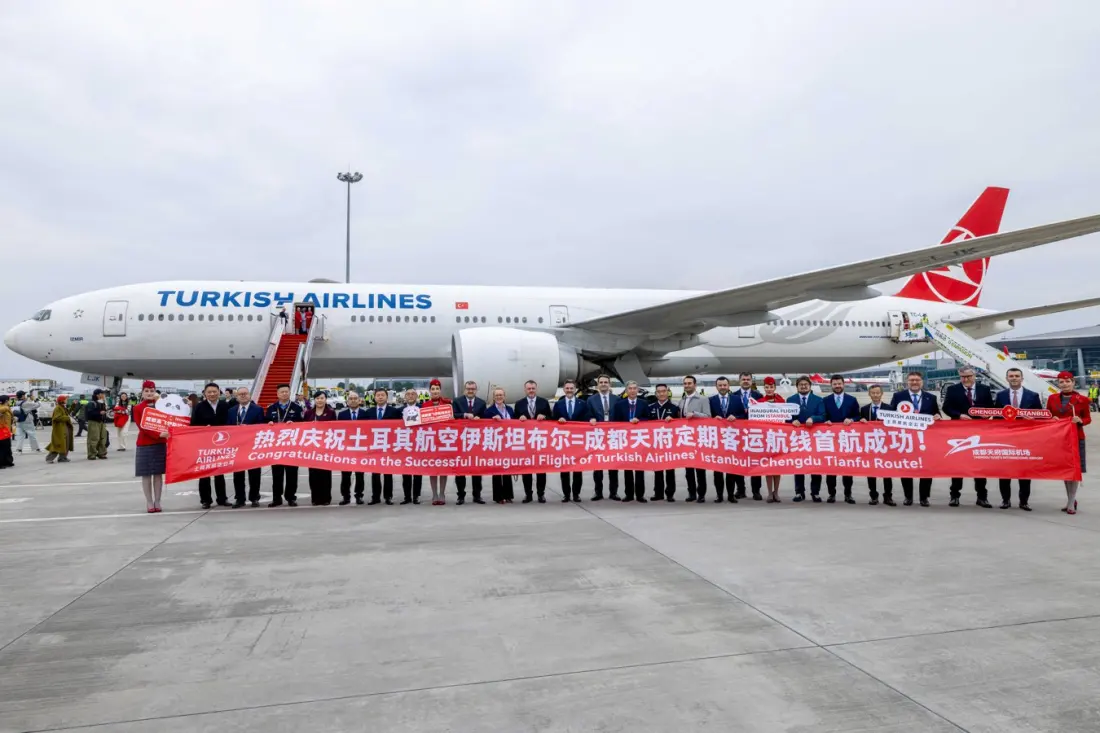
Chengdu is now on Turkish Airlines' map. The Istanbul-based carrier touched down in the Sichuan capital for the first time on 11 November, making it the airline's fourth Chinese destination alongside Beijing, Shanghai and Guangzhou. The service runs three times a week, connecting Istanbul with a city of more than 20 million people that most Western travellers still overlook.
Chengdu is one of China's fastest-growing hubs, particularly for trade, logistics and finance. Multinationals across electronics, automotive, aviation, biotech and artificial intelligence have set up shop there, so the new route will likely carry a healthy mix of business traffic in both directions. Turkish Airlines chair Murat Şeker framed the launch as a way to grow commercial, cultural and tourism links between Türkiye and China — which suggests the airline sees leisure demand too, not just suits and shipping.
For travellers, the appeal of Chengdu is easy to sum up: pandas, food and a slower pace than Beijing or Shanghai. The city is famous for its giant panda breeding base, where visitors can watch the animals up close in something close to their natural environment. Then there's the eating. Chengdu sits at the heart of Sichuan cuisine — mapo tofu, hotpot and the tingly numbing heat of Sichuan peppercorns — and UNESCO gave the city an official Creative City of Gastronomy badge back in 2010, the first in Asia.
Beyond the city limits, Chengdu works as a launchpad for Sichuan's big sights: Leshan's colossal riverside Buddha, the sacred peaks of Mount Emei, and the Jiuzhaigou valley further north with its turquoise lakes and waterfalls. It's also a popular entry point for travellers heading into western Sichuan's Tibetan regions.
There's a practical angle too. Turkish Airlines flies to more countries than any other carrier, and Istanbul is a one-stop option from much of Europe, the Middle East and Africa. If you've been pricing out flights to central or southern China and finding the fares or routings clunky, Chengdu may now be a smarter way in — and it's well connected to the rest of the country by high-speed rail, with Xi'an and Chongqing just a couple of hours away on fast trains.
Worth knowing before you book: three flights a week is a modest schedule, so dates and availability will be thinner than on the established Beijing and Shanghai routes. A visa or visa-free arrangement depends on your nationality and China's current entry rules, so check before you commit. And if you fancy adding a stopover in Istanbul to break up the trip — or tack on Cappadocia afterwards — the airline's hub makes that straightforward.
First seen on Nepali Times.