
Vietnam's aviation boom just got a formal stamp of approval in Paris. During a state visit by President Tô Lâm, two Vietnamese carriers signed agreements with Airbus covering more than 55 aircraft — a signal of how fast the country's air travel market is expanding.
The smaller of the two deals is also the more eye-catching. Vietravel Airlines, a carrier founded in 2019 that currently flies just five aircraft (one A320-200 and four A321-200s, including a couple of ex-Spirit Airlines frames), signed a letter of intent for up to 50 narrowbodies: 20 A220s and 30 A321neos or A321XLRs, with deliveries expected from 2029. For a tiny operator based at Hanoi and Ho Chi Minh City, that's a tenfold fleet expansion. The A220s would open thinner regional routes that don't currently support service, while the longer-range A321s could push the airline into Asia, Oceania and even the Middle East.
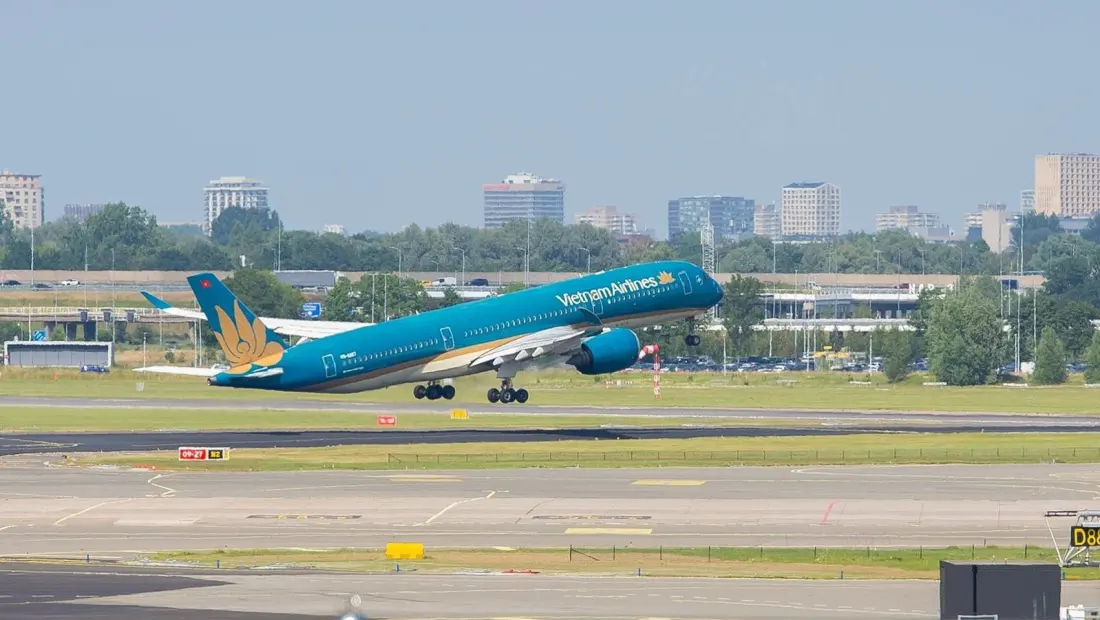
Flag carrier Vietnam Airlines, meanwhile, signed an MoU for five more A350-900s, adding to the 14 it already operates. The jets are slated for 2033-2034 arrivals and feed into a bigger ambition: the airline wants more than 30 new widebodies over the next decade as it explores routes to Europe, Australia and North America. It has already committed to 50 Boeing 737 MAX 8s for regional frequencies, so the two manufacturers are splitting the workload — Boeing on intra-Asia, Airbus on the long haul.
One caveat worth noting: neither deal is firm yet. Vietnam Airlines' agreement is a memorandum of understanding and Vietravel's a letter of intent, so both could change shape or shrink before deliveries begin.
Why does this matter to travellers? Because Vietnam has quietly become Southeast Asia's second-biggest aviation market, overtaking Thailand in seat capacity in July and August this year, according to OAG data — behind only Indonesia. More aircraft means more competition, more routes and, historically, better fares on a country that's already one of the region's best-value destinations. If Vietravel's plans hold, expect new direct connections from Hanoi and Ho Chi Minh City to places that currently require a stopover. And the deals weren't the only aerospace news from the visit — Vietnam's army is close to ordering Airbus NH90 helicopters for maritime security, part of a broader France-Vietnam package.
For now, the practical takeaway is simple: Vietnam's network is set to widen dramatically over the next five to ten years, and travellers planning trips in the second half of the decade will likely have far more options — both domestic and long-haul — than today.