Some narrowbody jets feel like a squeeze from the moment you board. The Airbus A220, originally developed as the Bombardier C Series before Airbus took over the programme, was designed from the ground up around the passenger experience — and it shows in five ways you'll actually notice on board.
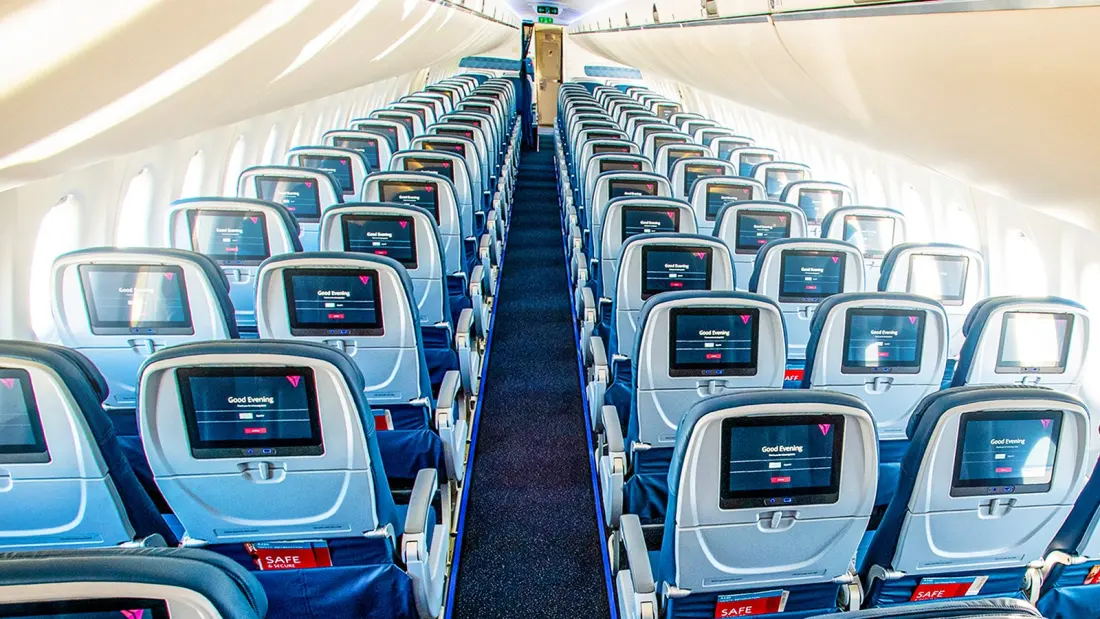
The big one is the seating. Instead of the usual three-three layout found on the Boeing 737 and A320 families, the A220 goes five-abreast: two seats on one side of the aisle, three on the other. Fewer middle seats means solo travellers have a better shot at a window or aisle, and couples can sit together without anyone drawing the short straw. Seats can run up to 19 inches wide depending on the airline — Delta's A220 Main Cabin seats measure 18.6 inches, the widest in its fleet — and the relatively straight sidewalls leave more room at shoulder height than cabins with heavily curved walls.
Then there are the windows. At roughly 11 by 16 inches, they're among the largest on any single-aisle aircraft, positioned close to eye level so you don't have to hunch to see out. More daylight floods the cabin, which makes even a full flight feel less boxed-in. Some Delta A220s even have a window in the rear lavatory, though that depends on the individual aircraft.
Noise is subtler but matters on longer sectors. The A220's Pratt & Whitney PW1500G geared turbofan engines are designed to run quieter and more efficiently than earlier-generation engines, and passengers often notice the calmer cabin at takeoff and cruise. It's not silent, and where you sit relative to the engines still makes a difference, but front-row-adjacent seats tend to be the pick for noise-sensitive flyers.
Storage and lighting round out the package. The original pivoting overhead bins are generous for a jet this size, and Airbus's new Airspace XL bins — launching with Air Canada — add 20% more volume and room for roughly 15% more carry-on bags, up to 19 extra on the A220-300. Full-spectrum LED mood lighting lets airlines shift the cabin between bright boarding modes and dimmed rest settings, with the newer Airspace interior capable of more than 16 million colours plus an extra light strip under the bins.
One caveat: the experience isn't identical across every A220. Seat pitch, recline, bins and finishes all depend on the carrier, so check the seat map for your specific flight rather than assuming the aircraft type guarantees the same comfort. Still, if your search turns up an A220 on a route where you'd otherwise face a six-abreast workhorse, it's usually worth choosing — especially if you're tall, travelling as a pair, or keen on a window with a proper view.