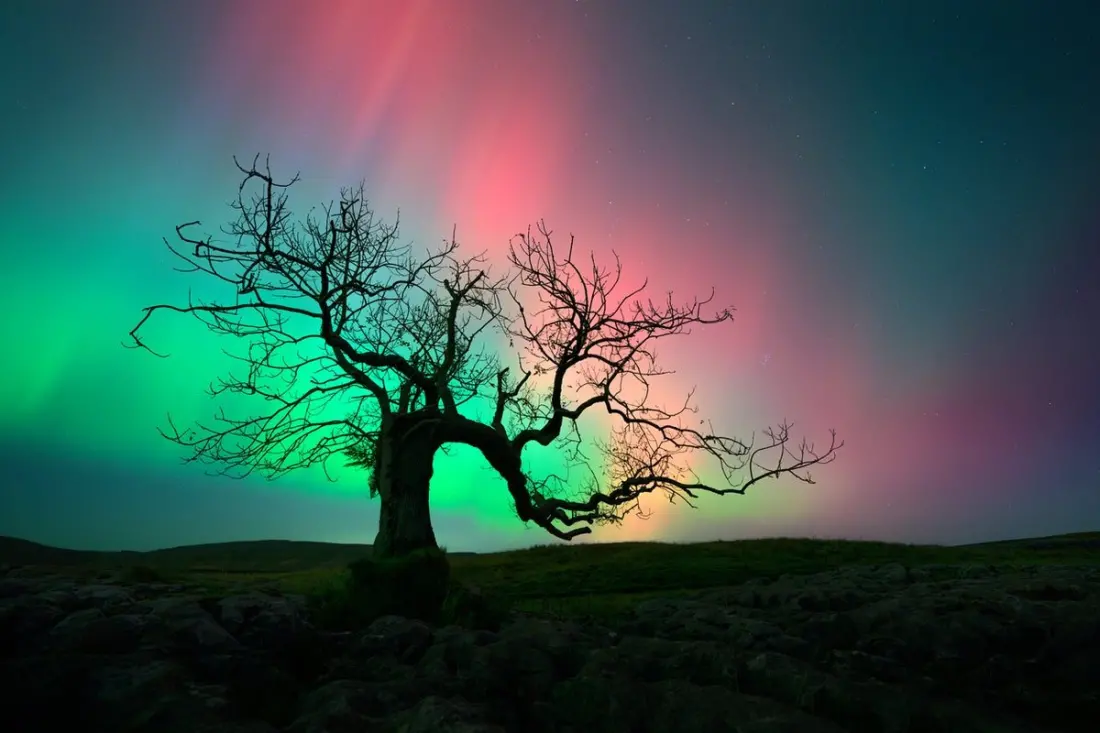
When a strong solar storm hits, the aurora borealis doesn't stop at Scotland — it can glow as far south as central and southern England, and a phone camera on long-exposure mode will often pick up colours the naked eye misses. The Met Office's Greg Dewhurst flagged exactly that during a recent display of green and purple skies, reminding UK stargazers that a once-in-a-lifetime trip to Norway isn't the only way to see the lights.
The science is simple enough: charged particles from the sun hit Earth's atmosphere and produce greens, yellows, purples and occasionally reds. Arctic countries get the regular shows, but Britain has a growing network of certified dark-sky locations where low light pollution and north-facing horizons give you a fighting chance.
Scotland leads the list. The Outer Hebrides — particularly Lewis and Harris — combine flat beaches with near-zero light pollution, so even on aurora-free nights you can pick out the Milky Way, the Orion Nebula and the Andromeda galaxy. Shetland, Britain's most northerly outpost over 100 miles from the mainland, gets a few displays each winter, and the island of Unst has a Wild Skies sky trail with marked viewing spots, benches and listening posts. The Cairngorms, the UK's largest national park, hold International Dark Sky status around Tomintoul and Glenlivet, though hills can block the view — coastal edges are often clearer.
England has serious contenders too. The Yorkshire Dales, one of the country's largest Dark Sky Reserves, counts around 2,000 visible stars on a clear night, with known spots including Tan Hill Inn and Buckden; a Dark Skies Festival is planned for February 2027. Northumberland National Park's skies are dark enough that the aurora has been photographed over Hadrian's Wall and Bamburgh after strong geomagnetic storms. The Lake District is a longer shot, but lakeside settings like Derwentwater, Wasdale and the Langdale Valley would make a dramatic backdrop. Even Suffolk now has skin in the game: the tiny hamlet of Thorington Street spent nine years earning England's first dark-sky community title, replacing its streetlights and opening a dark sky discovery centre in a Tudor barn.
Wales and Northern Ireland round things out. Eryri (Snowdonia) — 823 square miles of park with Wales's highest peak and 1,497 miles of footpaths — has recommended viewing at Llyn Geirionydd and Llyn y Dywarchen. Pembrokeshire's west-facing coast has dark-sky sites at Newgale Beach, Broad Haven, Skrinkle Haven and Garn Fawr. And OM Dark Sky Park in the Sperrin Mountains is Northern Ireland's only International Dark Sky Place, with a 14-inch telescope, guided tours and the Beaghmore Stone Circles, possibly an ancient observatory, next door.
Who should care? Anyone who wants a winter trip with a lottery-ticket bonus. The realistic season runs September to March across most sites — dark from late afternoon, so you don't need to endure Arctic cold at 2am. The aurora is never guaranteed anywhere in the UK, but every one of these spots delivers serious stargazing, walking and wildlife as the fallback, which makes the trip worthwhile either way.