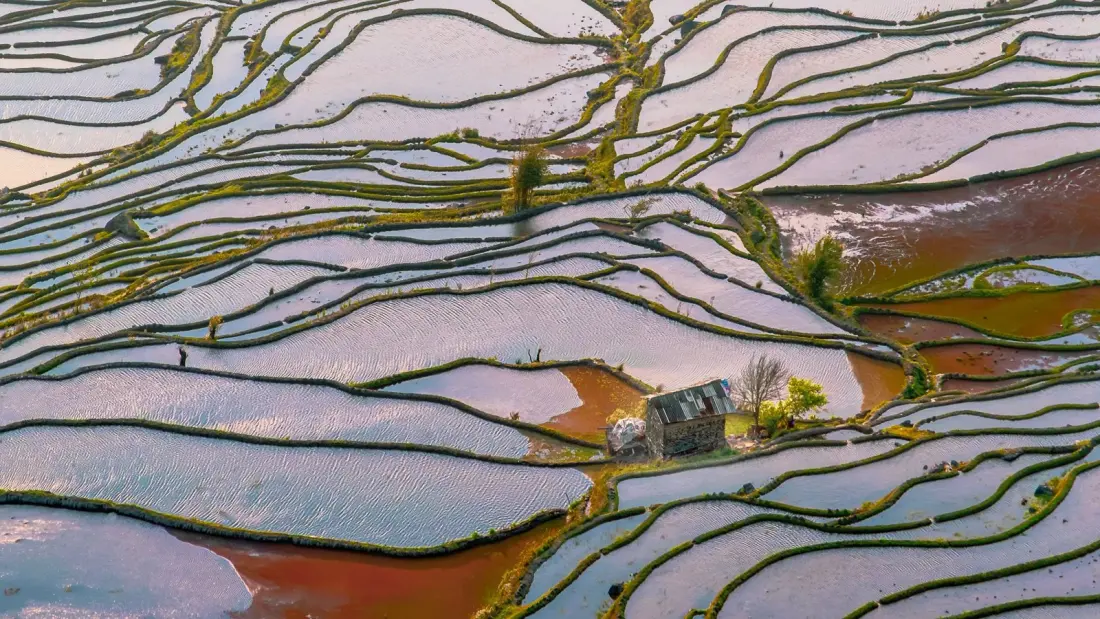
In the Ailao Mountains of southern Yunnan, the Hani people have been shaping steep slopes into rice paddies for well over a millennium. The result is Yuanyang County's staircase of thousands of terraces, a working landscape so significant that 16,603 hectares of it — the Cultural Landscape of Honghe Hani Rice Terraces — was inscribed on the UNESCO World Heritage List in 2013.
What makes the site remarkable is that it's a system, not just scenery. Forests on the ridge tops feed a water network of four main canals and 392 branch ditches stretching more than 445km, channelled down to the fields by communities who share responsibility for keeping it running. Farming here mixes it up: water buffalo plough, fish and ducks live in the paddies, and red rice is the main crop. It's generations of mountain know-how in practice.
The heritage area also takes in 82 villages, traditionally sited between the upper forests and the fields below. Hani houses often have distinctive thatched roofs and are built from earth, adobe and stone, with the surrounding mountains, forests and waterways carrying spiritual meaning. Crucially, this isn't a museum piece — people still farm here, and tourism exists alongside a living agricultural economy.
Timing shapes the experience. Between November and April the flooded terraces act like mirrors, catching the sky at sunrise and sunset — the classic photo window. May and June bring planting and fresh green slopes; by September the fields turn golden ahead of harvest. Three viewpoints do most of the heavy lifting: Duoyishu for sunrise, Bada for wide views and sunsets, and Laohuzui (Tiger's Mouth) for drama — though it has closed at times, so check access before you go. Fog is a regular guest, so build in slack rather than betting everything on one sunrise.
Yuanyang is reached overland from Kunming, Yunnan's capital, with a journey of several hours depending on connections. Once there, the viewpoints are scattered across mountain roads, so hiring local transport or a guide earns its keep, especially for dawn and dusk runs. Pack shoes with decent grip, stick to paths around private farmland, and ask before photographing residents.
For travellers, Yuanyang rewards patience and slow looking. The terraces are impressive from any angle, but the real story is the water management and community cooperation that keep them producing food 1,300 years on — something UNESCO's listing explicitly recognises. Whether that heritage survives depends on traditional farming staying viable for the Hani communities themselves, which makes respectful, low-impact visits all the more worthwhile.
Story sourced from Getaway South Africa.