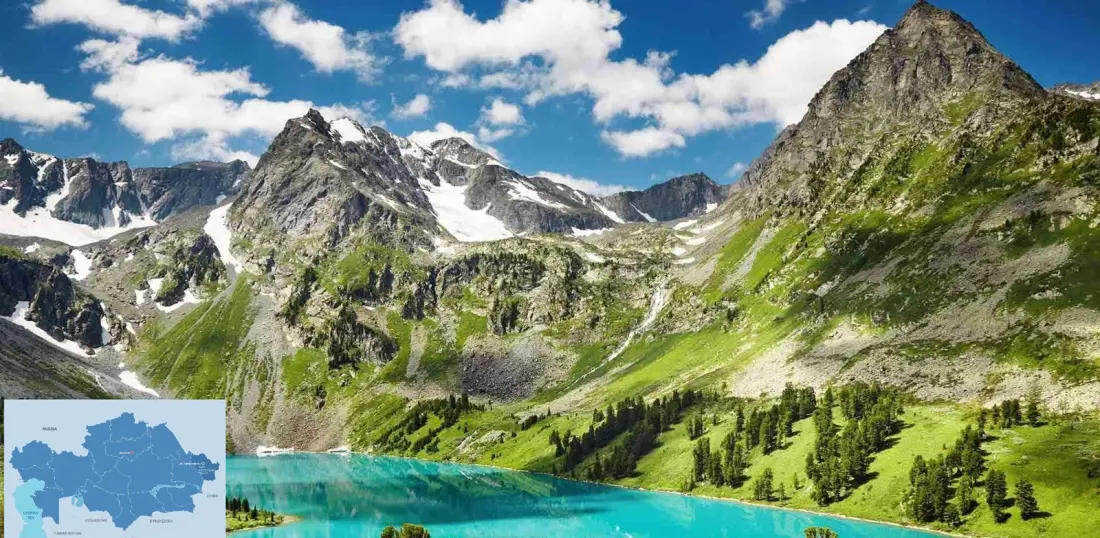
Getting to Rakhmanov Springs in East Kazakhstan used to mean grinding up an unpaved mountain track for up to three hours. Since October 4, a freshly repaired 13-kilometre stretch of the Oskemen-Altai-Ulken Naryn-Katon-Karagai-Rakhmanov Springs highway has cut that ordeal down, adding designated viewpoints along the way and making one of the Altai's best-known wellness spots reachable in an ordinary passenger car when conditions are good.
The springs sit near Rakhmanov Lake inside Katon-Karagai State National Nature Park, a 643,000-hectare protected area bordering Russia and China. It is the centrepiece of a region that drew roughly 446,000 tourists in 2025, including more than 26,000 to the park itself. The radon-rich thermal waters are the headline draw, but the surrounding area adds waterfalls, forest trails and Altai mountain viewpoints.
Local operators suggest a three- to five-day itinerary to cover the park's highlights: hiking routes for various fitness levels, maral deer farms, apiaries and cultural sites. Ambitious travellers aim higher, towards Muztau (Mount Belukha), the Altai's highest peak at about 4,506 metres. Overland expeditions to its foothills typically take eight to ten days with horseback support; helicopter day trips are a faster, weather-permitting alternative. A new route launched in September, Altai Trails, runs from near Rakhmanov Springs through the Sarsembay tract towards the mountain, offering an option around older trails blocked by rough terrain and border-zone rules.
The district also has an archaeological angle. Near the village of Berel, excavations of Saka-era burial mounds more than 2,000 years old have yielded preserved horses, textiles and ceremonial objects, now showcased at the Berel State Historical and Cultural Museum Reserve.
With a week or more, head further afield: Lake Markakol, a 38-kilometre alpine lake at 1,447 metres, pairs well with the Old Austrian Road, a remote mountain route built by Austro-Hungarian prisoners of war in the early 20th century and now popular for off-road trips. Operators recommend five days for that combination, with a season from roughly mid-June to late August. Elsewhere, the eroded red clay ridges of Kiin-Kerish look like a desert dropped into the mountains, while the Bukhtarma Reservoir serves up low-key summer beach and boating holidays. Come winter, skiers and snowmobilers head for Ridder and the resorts near Oskemen, including Altai Alps and Nurtau.
More help is coming: a new airport in Katon-Karagai District, with a 2,200-metre runway and a terminal for 150 passengers an hour, is due to finish by the end of 2026, though no scheduled flights have been announced yet.
For now, planning is everything. Distances between attractions run 400-500 kilometres, fuel and phone coverage can be scarce, and summer demand for guides, vehicles and rooms outstrips supply. Operators strongly advise booking guides and accommodation well in advance and packing warm layers, since temperatures swing sharply even in July. Some protected and border areas require permits. Costs range from about US$45-65 for day hikes to US$110-220 per person per day on organised multi-day tours, with helicopter and premium programmes reaching US$1,100-2,200 or more.
The Astana Times