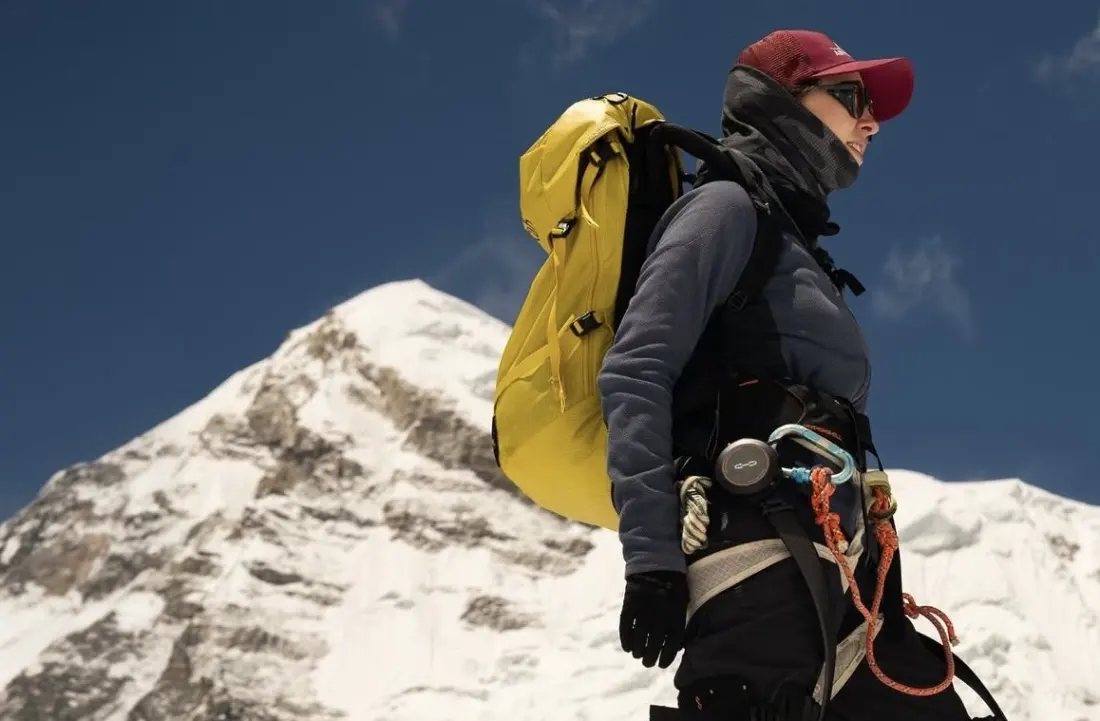
During this year's spring climbing season, wearable robotic exoskeletons helped climbers reach the top of Mt Everest. It's the biggest shift in Himalayan mountaineering since bottled oxygen — and it's already trickling down to ordinary trekkers.
Exoskeletons are robotic frames worn on the legs, hips and lower back that give powered assistance when walking, climbing or carrying loads. Battery packs on current models deliver roughly 30km of hiking or four hours of climbing per charge. Devices like the Hypershell X Ultra retail for around $2,000, and the Hypershell X series has already been up Everest. Elsewhere in the region, Arc'teryx MO/GO hiking trousers with battery-powered carbon fibre springs are helping elderly pilgrims circle Mt Kailash, Chinese firm Kenquin rents out π-series exoskeletons to tourists on Mount Tai, and Kathmandu operator Pumori Journeys is trying them on valley hikes.
For Nepal's mountains, the practical promise is real: powered assistance can cut physical effort by 20-40%, which could lighten loads for porters and let rescue teams reach stranded climbers faster. National Geographic explorer Ben Ayers, co-founder of Everest Live, expects demand to drive adoption across 8,000m peaks including Lhotse, Makalu, Annapurna and Dhaulagiri.
But there's a catch, and it echoes the bottled-oxygen problem. Oxygen gives paying clients a life-saving edge in the Death Zone, yet it takes an army of unassisted porters to haul the bottles uphill — porters who must keep pace with artificially enhanced clients. A $2,000 suit on a client's legs while the porter carrying their gear has none would recreate the same imbalance. Ayers worries the tech will mostly benefit less experienced climbers and could erode the already undervalued role of porters.
Not everyone sees a crisis. Alpinist Billi Bierling of the Himalayan Database points out that climbing 'ethics' have shifted constantly — supplemental oxygen was once scandalous, and nobody calls Mont Blanc expeditions cheating for starting above the Aiguille du Midi cable car. She also notes the purity argument mostly comes from foreign elite climbers, not Nepalis, in an industry that employs tens of thousands and brings in $8 million in royalties plus an estimated $200 million in wider economic activity. Expect a new taxonomy, though: summits flagged as 'exoskeleton assisted' or not, much like oxygen-free claims today.
For travellers, the near-term story is simpler than the ethics fight. If you've written off a Himalayan trek because of knees, age or fitness, powered hiking gear is arriving in the region now, and prices will only fall. Watch for the Nepal government's stance on regulation — experts argue policies are needed so a tool meant to lighten porters' loads doesn't instead add risk to the people who carry the industry on their backs.
Thanks to Nepali Times for the original reporting.