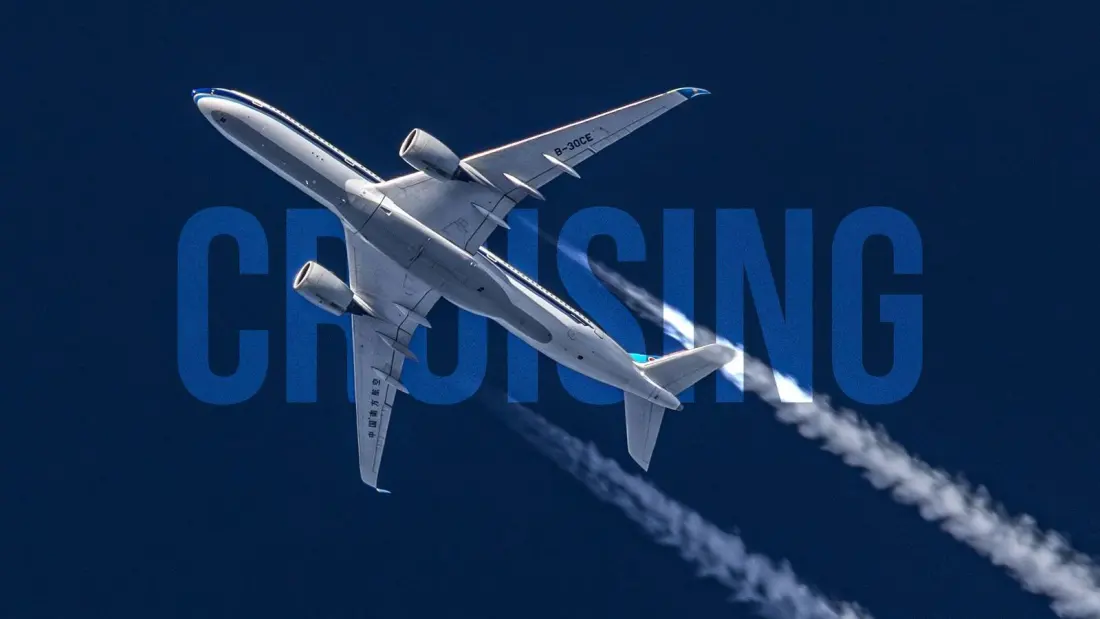
Check the seatback map an hour into almost any long flight and the altitude reads somewhere near 35,000 feet. That's not a regulation or an airline tradition. It's the point where a bunch of competing constraints happen to balance out — and it shifts as the flight goes on.
The case for flying high is fuel. At 35,000 feet, air is only about 31% as dense as at sea level, and drag — the biggest fuel penalty an aircraft fights — drops accordingly. Temperatures up there sit around minus 54°C, and modern swept-wing jets typically cruise at Mach 0.78 to 0.85, roughly 515 to 560 mph. Flying lower means more than double the air resistance at 10,000 feet, plus weather and traffic.
But thin air cuts both ways. Wings need air density to generate lift, and engines need oxygen to burn fuel, so climbing forever isn't an option. The practical ceiling for sustained efficient cruise on today's widebodies is around 41,000 to 43,000 feet. Push higher and you approach 'coffin corner' — the zone where the stall speed and the maximum speed limit converge, leaving almost no margin. The Lockheed U-2 spy plane, at 70,000 feet, can fly with as little as five or six knots between those boundaries. Commercial jets stay well clear, with certification requiring a cushion of at least 0.3 g.
The optimum altitude isn't fixed anyway. A long-haul jet burns off tons of fuel as it goes, getting lighter and able to climb. On a Dubai-to-London 777-300ER, the ideal level might start near 31,000 feet and end near 39,000. Crews make staged 'step climbs' of 2,000 or 4,000 feet — worth an estimated 1-3% of total fuel on 12- to 16-hour flights.
Then air traffic control gets a say. Preferred altitudes may be occupied, winds can cancel out the benefit of a higher level (jet stream cores hit 140-290 mph), and flight levels are organised by direction — odd numbers for easterly courses, even for westerly in US airspace, with RVSM keeping aircraft just 1,000 feet apart. Eurocontrol estimates European flights burn about 5% more fuel than they would if crews could always fly their optimal level, which is why programs like SESAR and NextGen are pushing for freer trajectories.
For passengers, this explains a couple of in-flight curiosities: why the plane climbs partway through a long flight, and why the crew occasionally level off lower than they'd like. It also puts the familiar 35,000-foot figure in context — less a magic number than the middle of a managed compromise between fuel bills, physics and traffic flow. Next-gen aircraft like the A350 and 787 already cruise a bit higher than older designs, but the fundamental trade-off between efficiency and safety margin isn't going anywhere.