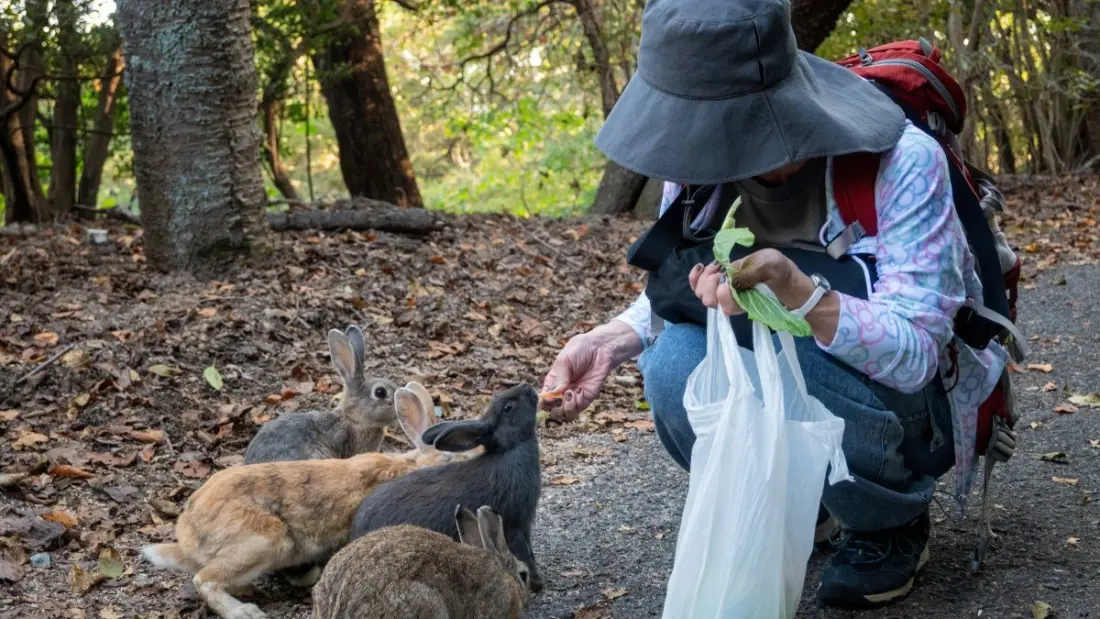
Hundreds of rabbits hop freely around a tiny island in western Japan, and that alone draws huge crowds. Okunoshima — better known as Rabbit Island — sits in the Hiroshima region, has a circumference of just 4 kilometres, and pulled in roughly 200,000 visitors last year. Tourists hand-feed bunnies that come right up to them, an up-close animal encounter you rarely get anywhere else.
But the fluffy population hides a serious story. In 1929, the Imperial Japanese Army built a secret chemical weapons factory here, hoping to match European capabilities despite international bans introduced after World War I. The island produced poisons including mustard gas and lewisite, and because the operation was so classified, authorities literally erased Okunoshima from Japanese maps until the end of World War II in 1945, when Allied occupation forces ordered the facility destroyed.
The human cost was heavy. Many factory workers later suffered from cancer and other illnesses, something commemorated by a monument on the island. Rabbits were reportedly used in experiments there too, though experts say today's population — thought to descend from a small group released by a nearby elementary school in the 1970s, now numbering around 500 — is not linked to those animals. The island also hosts a Poison Gas Museum, whose director has spoken about how Japan feared sanctions if the facility were ever exposed, given its reliance on imports at the time.
Visitors can still see the ageing concrete and brick structures scattered across the island — former power plants and poison gas depots — standing between the burrows. For many travellers, that contrast is the point. One Japanese visitor described it as a tragic legacy, but said he was glad the island had become a place where rabbits could live peacefully.
There's also a modern wrinkle worth knowing before you go. A study published in July warns that heavy tourist feeding is disrupting the island's ecosystem. Wild boars, drawn in by the food, have been observed attacking the rabbits, and the constant grazing has stripped low-lying leaves and branches from many plants. Rabbits also face shortages on quiet days when few tourists show up. Local guides are asking visitors to resist feeding the animals, arguing that a growing rabbit count doesn't equal healthy animals.
So Rabbit Island works on two levels. It's an easy, charming day trip with hundreds of friendly bunnies — and it's a sobering piece of wartime history, complete with ruins and a museum that puts the cuteness in context. Go for both.