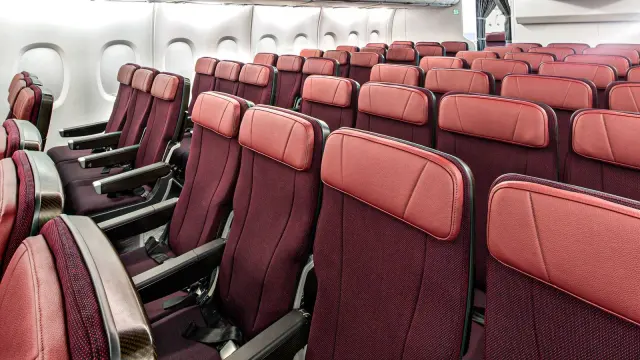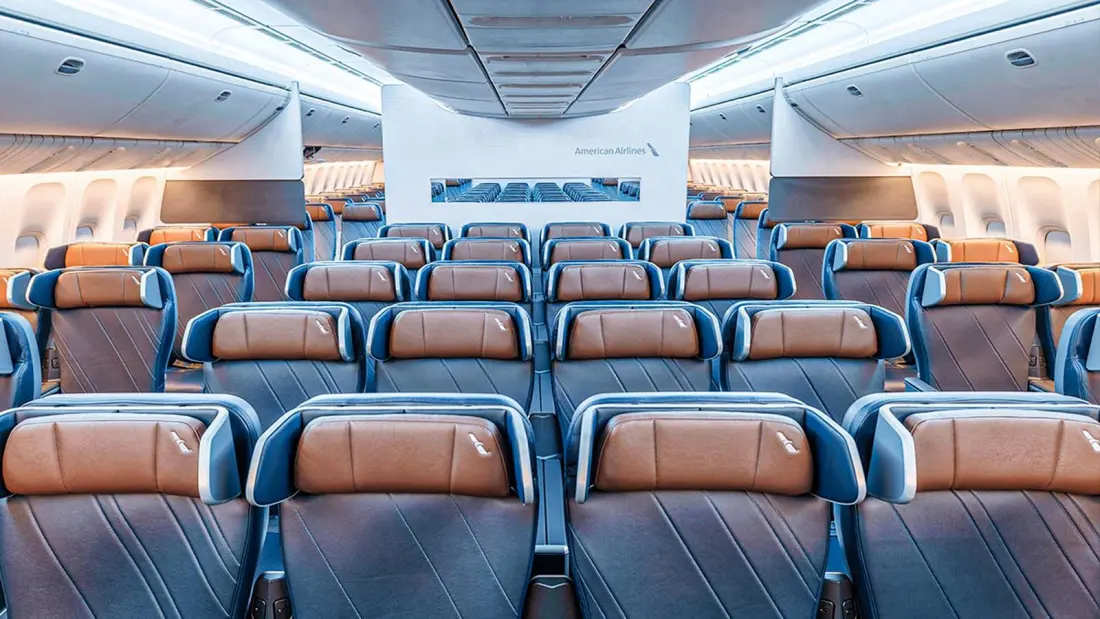
There was a time when a long-haul economy ticket came with roughly 34 inches of seat pitch — enough legroom to shift position, stretch out and survive an overnight flight without dreading it. These days, that amount of space is increasingly sold as an upgrade. Standard economy across most long-haul carriers now sits at 30 to 31 inches, and the room you used to get by default has quietly become a product with its own price tag.
Pitch — the distance between one row and the next — is the key measurement here. Losing four inches sounds trivial on paper, but over a ten-hour flight it's the difference between crossing your legs comfortably and spending the night with your knees pressed into the seatback. It matters even more when you factor in how many seats airlines squeeze across each row: Boeing 787s typically fly in a 3-3-3 economy layout, while a Boeing 777 can be configured 3-4-3, adding an extra seat per row.
The driver is money per square foot, not just headcount. Industry estimates put business class revenue at four to five times that of economy for the same floor area, while premium economy can bring in roughly 1.8 to 2.4 times economy's revenue using only about 1.5 times the space. That maths explains the "barbell" cabin many airlines now run: a dense, cheap economy section at one end, a luxurious business cabin at the other, and premium economy catching everyone in between.
The numbers back this up. US premium seat capacity has grown 33% since 2020, against 16% for economy. Delta's premium ticket revenue even edged past its main cabin revenue in one recent quarter — roughly $6.82 billion versus $6.80 billion. At the opposite end, basic economy strips out seat selection, bags and flexibility to compete with low-cost carriers, leaving standard economy squeezed from both directions.
For travellers, the practical takeaway is that the ticket price alone no longer tells you what you're buying. Before booking a long-haul flight, check the actual seat pitch and width for your specific aircraft — configurations vary even within the same airline's fleet. Read the fare rules too, since a cheap base fare can look less appealing once seat selection and baggage fees are added. And watch for premium economy pricing that sits suspiciously close to business class: sometimes the genuine value move is comparing all three cabins, including what each includes, rather than assuming the middle one is the sweet spot.
None of this means every economy seat is shrinking — some airlines still offer 32-34 inches on certain routes. But the broader trend is hard to miss: comfort that once came with an ordinary ticket now lives behind a fare-category paywall. Knowing your pitch figures, seat maps and aircraft types before you pay is the best defence against discovering the difference at 35,000 feet.