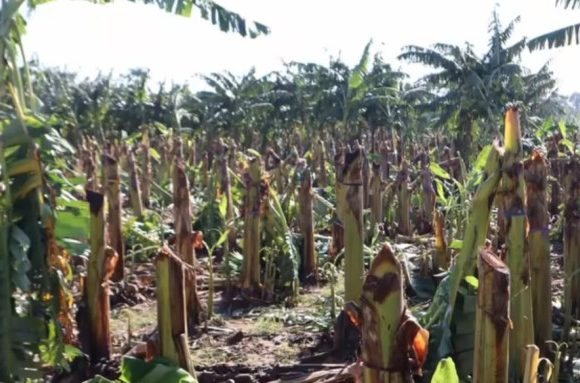
A brief but violent storm swept across the Cibao region of the Dominican Republic on a Wednesday afternoon, leaving a trail of flattened crops and flooded streets. Around 5:00 p.m., what local agricultural officials describe as a small tornado touched down near Palo Amarillo, close to the town of Mao in Valverde province, accompanied by heavy rain that continued into the evening.
The winds hit the country's banana belt hard. One export banana farm near Mao, owned by producer Guarionex García, saw roughly 150 of its 330 acres knocked down while the plantation was in full production — a blow to a business earning around $10,000 a week. Another grower, Arismendi Tolentino, lost more than 90% of his 50 acres of bananas, according to preliminary official assessments. Technicians from the Ministry of Agriculture, including Northwest Cibao regional director Alfonso Antonio Rodríguez, have been sent to survey the plots and work out what support farmers might receive. Damage was also reported in Hatillo Nuevo, Hierba de Guinea and other farming communities.
The rain caused wider problems beyond the fields. In Santiago, the country's second city, Civil Defense counted at least 150 flood-affected homes in a single night — about 100 in Hoya de Caimito and 50 in Francisco del Rosario Sánchez. Major roads including 27 de Febrero Avenue, Estrella Sadhalá Avenue and Circunvalación Sur were underwater, snarling traffic. In one alarming incident, a woman fell into an open manhole on Circunvalación Sur while crossing during the downpour; bystanders pulled her to safety. Regional Civil Defense chief Francisco Arias warned that fast-moving water can shift drain covers, and that theft of covers makes some streets even riskier.
For anyone travelling to or through the Dominican Republic's northwestern interior, this is a useful reminder that the Cibao valley — the agricultural heartland between Mao and Santiago — sits squarely in the path of the intense afternoon downpours typical of the Caribbean wet season, and occasionally worse. If you're driving between Santiago and the north coast or visiting the region during heavy rain, avoid flooded roads and standing water, allow extra time for journeys, and keep an eye on official Civil Defense updates. Popular tourist zones on the coast were not the focus of this event, but the corridors and rural areas travellers pass through can be affected when storms like this hit.