A ninth-century Bodhisattva Padmapani stolen from Kathmandu's Boudhanath Stupa was seized at Bengaluru airport last April, arriving in a cargo consignment from Vienna declared as a 'grey stone stele'. The seizure capped months of work by heritage activists who had spotted the piece at an Austrian auction gallery and alerted the authorities on both ends.
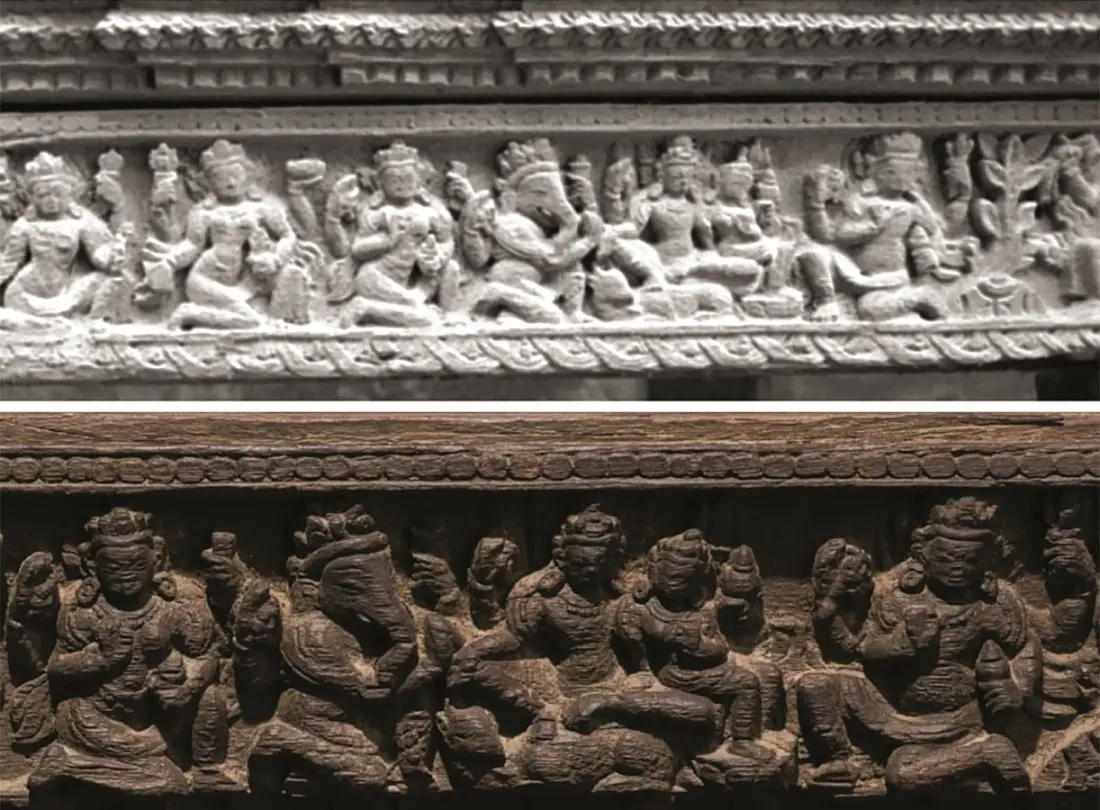
It was one of six artefacts from the Kathmandu Valley flagged by the Lost Arts of Nepal page ahead of two Vienna auctions in March and April 2025, all with strong evidence — books, archives and dated photographs — that they were looted from active shrines. A 19th-century repoussé of Chamunda linked to the Balkumari Temple in Thimi opened at €500 and sold for €2,016. A wooden frieze from the 18th century was pulled from sale after groups submitted photographic proof of its origin. A Ganesh stele traced to Kirtipur's Bagh Bhairav temple was relisted for April 2026.
The clearest case was a Shridhar Vishnu relief from Chyasalhiti in Patan. Starting at €7,500, it matches piece 140E in Ulrich von Schroeder's Nepalese Stone Sculptures and plate 186 in Lain Singh Bangdel's Stolen Images of Nepal — which explicitly notes it was stolen in the early 1980s. Matching damage to a hand, a mace and a Garuda figure, plus an identical height of 52cm, and a 1976 in-situ photo on the gallery's own listing sealed it. It sold anyway, for over €9,000.
One story is ending better. An 18th-century wooden panel from the Kaasthamandap — Kathmandu's oldest structure, said to have given the city its name, rebuilt after the 2015 earthquake — is set for voluntary return. The 3.6-metre carved panel, inherited by Peter Kienzle-Hardt from his father's Asian collection, will go back onto the temple with a repatriation plaque. There's precedent: a Dipankar Buddha head Kienzle-Hardt tried to sell in 2001 turned out to have been stolen from Patan's Nagbahal the year before, and was returned — it now appears in the annual Samyak Mahadan festival.
Why should travellers care? These aren't museum pieces gathering dust. In the Kathmandu Valley, gods are living fixtures of daily life — worshipped on the walk to school or the vegetable market — and repatriated deities are increasingly reconsecrated in their original temples. Communities remember seeing them as children. A Nepal law from 1956 restricts export of any artefact over a century old, but few thefts were formally reported to police; replicas were often installed instead, which auction houses have used to argue the objects were sold willingly. Activists with the Nepal Heritage Recovery Campaign argue the burden of proof should sit with sellers to show legal export papers.
For visitors to Kathmandu, Patan and Kirtipur, it's a reminder that the carvings on local temples carry living histories — and that spotting a familiar deity back on its shrine after decades abroad is a genuinely emotional community event. Spotting one at a European auction, less so. The story continues: the Ganesh stele returns to the block in 2026, and campaigners aren't letting up. — Nepali Times