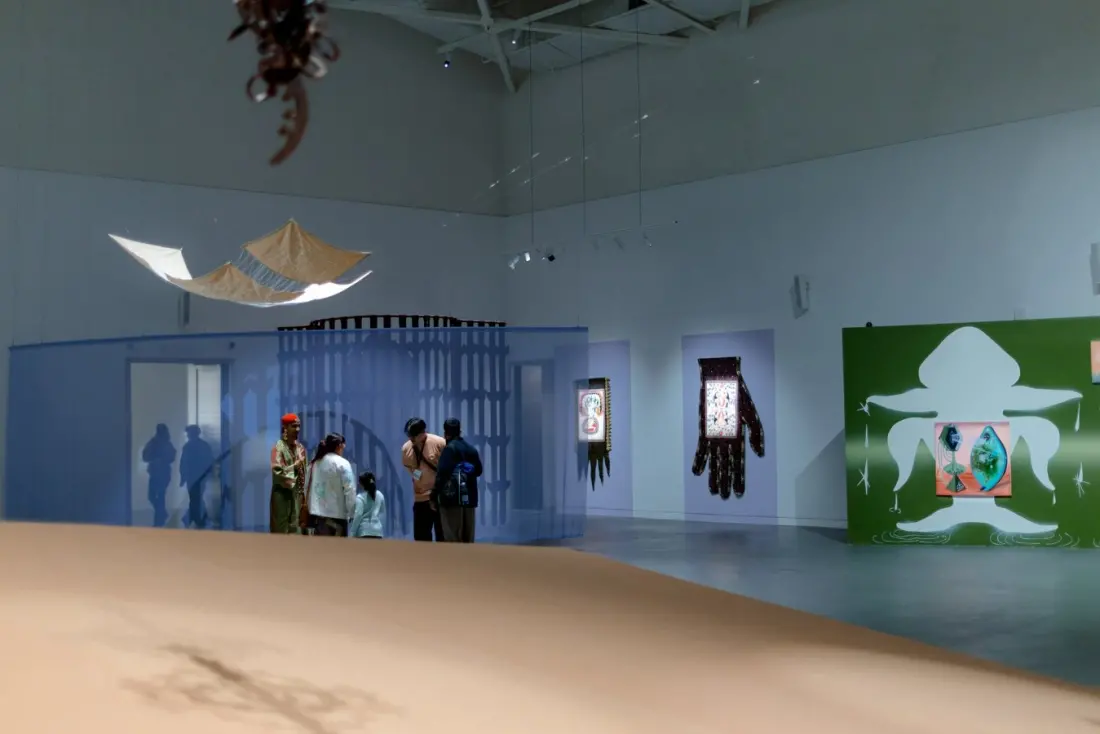
Almaty's cultural calendar has a new anchor for the winter months: "Himoya: Matrilineal Energies, Oracular Kin," an international exhibition at the Tselinny Center of Contemporary Culture that opened on October 15 and runs until April 4, 2027. It gathers 21 artists and thinkers from Central Asia and further afield, curated by Natasha Ginwala, to explore how knowledge, rituals and family stories pass down through women across generations.
The title comes from a word meaning protection or care that appears in Uzbek, Arabic, Azerbaijani and Sanskrit traditions, and the show treats ancestral knowledge not as a museum relic but as something alive. Sculpture, sound, installation and performance all feature, alongside workshops and a research programme. The venue itself adds weight: Tselinny is a converted Soviet cinema, and the exhibition design by Diogo Passarinho Studio plays on that history.
Several works stand out for travellers curious about the region. Uzbek artist Aziza Kadyri's "Iron Mother" is an interactive installation built around her grandmother Umida, who oversaw construction of the Tashkent TV Tower and later became its first director — a story that never made the official Soviet record. Visitors step into a dismantled TV studio and control room and decide how Umida's voice gets heard, a neat commentary on who controls women's narratives.
South Korean artist Haegue Yang contributes "The Bear-Woman's Story in the Sand Cave," an audio piece recorded locally in four languages: Kazakh, Russian, English and Koryo-mar, the language of ethnic Koreans in Kazakhstan. Yang's research trips to petroglyph sites around Almaty shaped new sculptures inspired by the asatayak, a traditional Kazakh percussion instrument. Colombian artist Ana María Millán, meanwhile, developed a video-game-style animated work through role-play workshops with Almaty residents, linking Kazakhstan and Colombia through themes of care and women's autonomy.
The wider artist list includes Almagul Menlibayeva, Umida Akhmedova, Ahmed Umar, Rajni Perera and many others, with references to Tengrian traditions, ancient Turkic mythology and spiritual cosmologies woven throughout. Support comes from the SÄR Foundation, plus partners including the Korean Cultural Center in Kazakhstan and the Office for Contemporary Art Norway.
For anyone visiting Almaty between now and early April, this is an easy win: a serious contemporary art show that doubles as a crash course in Central Asian history, memory and identity, all inside one of the city's most atmospheric buildings. Pair it with Almaty's mountains, bazaars and coffee shops for a rewarding city break.