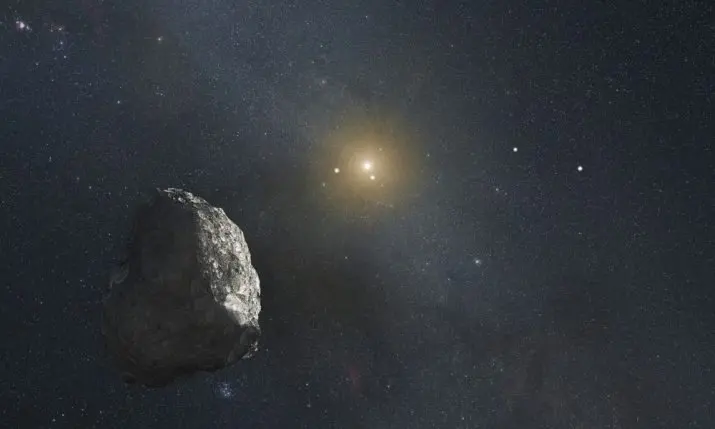
Somewhere between Mars and Jupiter, an asteroid now carries a Croatian surname. The International Astronomical Union has approved the name Dankobosanac for asteroid 182786, honouring the late physicist Professor Slobodan Danko Bosanac, who died in 2026 after a career spent championing astronomy and space science in Croatia.
The asteroid itself is a product of a long-running sky survey: it was spotted on 18 December 2001 by the Sloan Digital Sky Survey at the Apache Point Observatory in New Mexico. Among the discovery team was Croatian astrophysicist Professor Željko Ivezić, who later put Bosanac's name forward on behalf of the Adriatic Aerospace Association (A3), the non-profit he helped found to connect Croatian researchers with high-tech companies working on aerospace projects. Orbiting the Sun roughly every 5.5 years, the asteroid now permanently bears a name that will stay in astronomical records indefinitely.
Who was the man behind it? Bosanac built much of his career at the Ruđer Bošković Institute in Zagreb, with research stints in the United Kingdom and the United States along the way. His published work runs to around 100 scientific papers and several books, spanning molecular and theoretical physics. But the IAU citation highlights something else: his talent for bringing science to the public and inspiring younger generations to look up.
Two initiatives stand out. In 1986 he launched the Brijuni Conferences, an international scientific meeting held on Croatia's Brijuni islands that continues to draw researchers from many disciplines. Decades later he established A3, arguing that a small country could benefit from participating in space programmes — not for prestige, but because space research drives innovation and technology back on Earth.
For travellers with an interest in science, the story is a reminder that Croatia's appeal stretches well beyond the Adriatic coastline. Zagreb's Ruđer Bošković Institute remains a working research hub, and the Brijuni archipelago — a national park off the Istrian peninsula near Pula — is easy to visit by boat and pairs its scientific legacy with Roman ruins, dinosaur footprints and safari park oddities left behind from Tito's era. It's a low-key day trip that now has an extra footnote in the history of space science.
Why care about a rock with a name? Asteroid namings are rare honours, and this one ties together a Croatian scientist, a New Mexico observatory and a Croatian-born astronomer who helped find it. For anyone visiting Croatia and curious about the country's scientific side, it's a neat thread to follow — from a Zagreb lab to a chunk of rock tumbling through the main asteroid belt, with the Brijuni islands sitting right in the middle of the story.