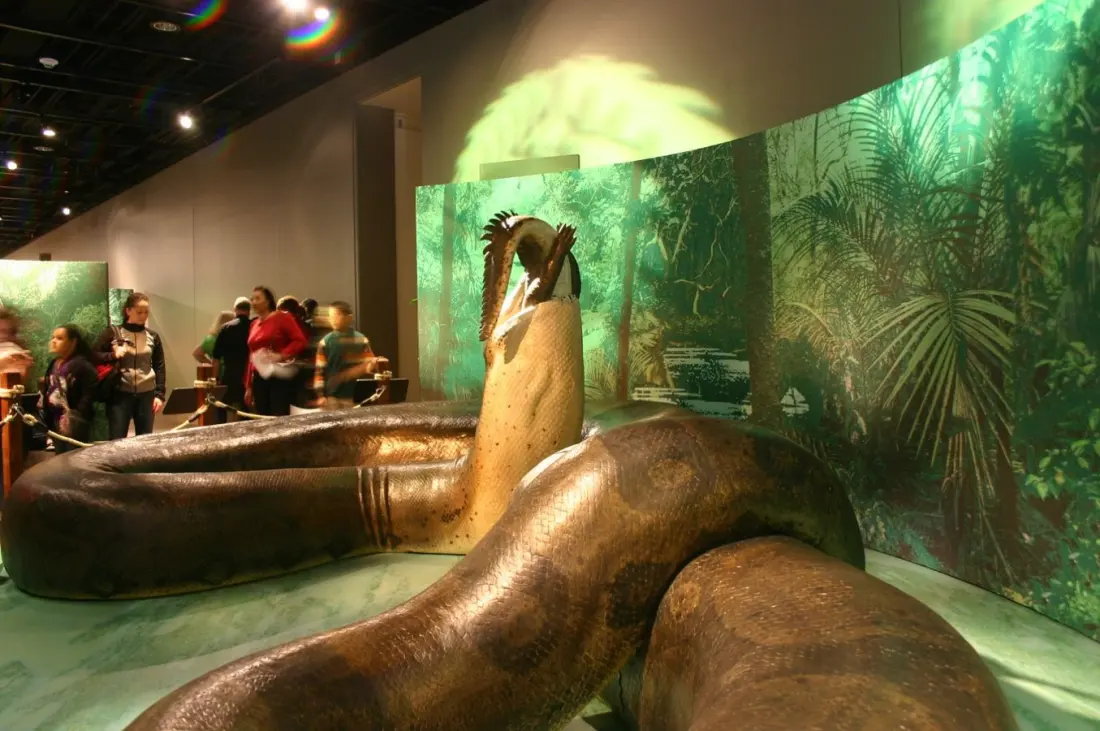
A snake longer than a bus once lived in northern Colombia. Titanoboa cerrejonensis, unearthed in a coal mine in La Guajira, stretched an estimated 12.8 to 15 metres and weighed over a metric tonne — the largest snake ever found in the fossil record.
The first bones surfaced in 2005 at the open-pit El Cerrejon mine, when Colombian palaeontologist Edwin Cadena spotted remains so outsized that researchers initially wondered if they belonged to a giant crocodile. Later expeditions recovered skulls, vertebrae and ribs from roughly 30 specimens, and in February 2009 the discovery landed on the cover of Nature, with research led by teams from the Smithsonian Tropical Research Institute and the Florida Museum of Natural History.
The find matters beyond the shock value of a one-tonne constrictor. Around 60 million years ago, in the Paleocene just after the dinosaurs died out, La Guajira was nothing like the arid peninsula it is today — it was a humid tropical rainforest threaded with rivers, home to giant crocodiles, oversized turtles and very large fish. Because reptile size tracks ambient temperature, Titanoboa's bulk is also a proxy for how warm the tropics were back then, making the fossils a genuine climate archive.
For travellers, there's now a straightforward reason to see it in person. The José Royo y Gómez National Geological Museum in Bogotá, run by the Colombian Geological Survey, holds the original vertebrae and ribs, and in August 2024 it opened an exhibition — "Titanoboa cerrejonensis: One of the Largest Snakes That Ever Existed" — displaying the real fossils publicly in Colombia for the first time, complete with size comparisons against a modern anaconda.
If you're planning a Colombia trip with a science bent, Bogotá's museum pairs naturally with the capital's other attractions, while hardcore fans can push north to La Guajira to see the landscape that once hosted the giant — today a stark, windswept desert of dunes and flamingo lagoons near Cabo de la Vela and Punta Gallinas. Either way, it's a reminder that the country is as compelling for its deep past as for its beaches and coffee hills.