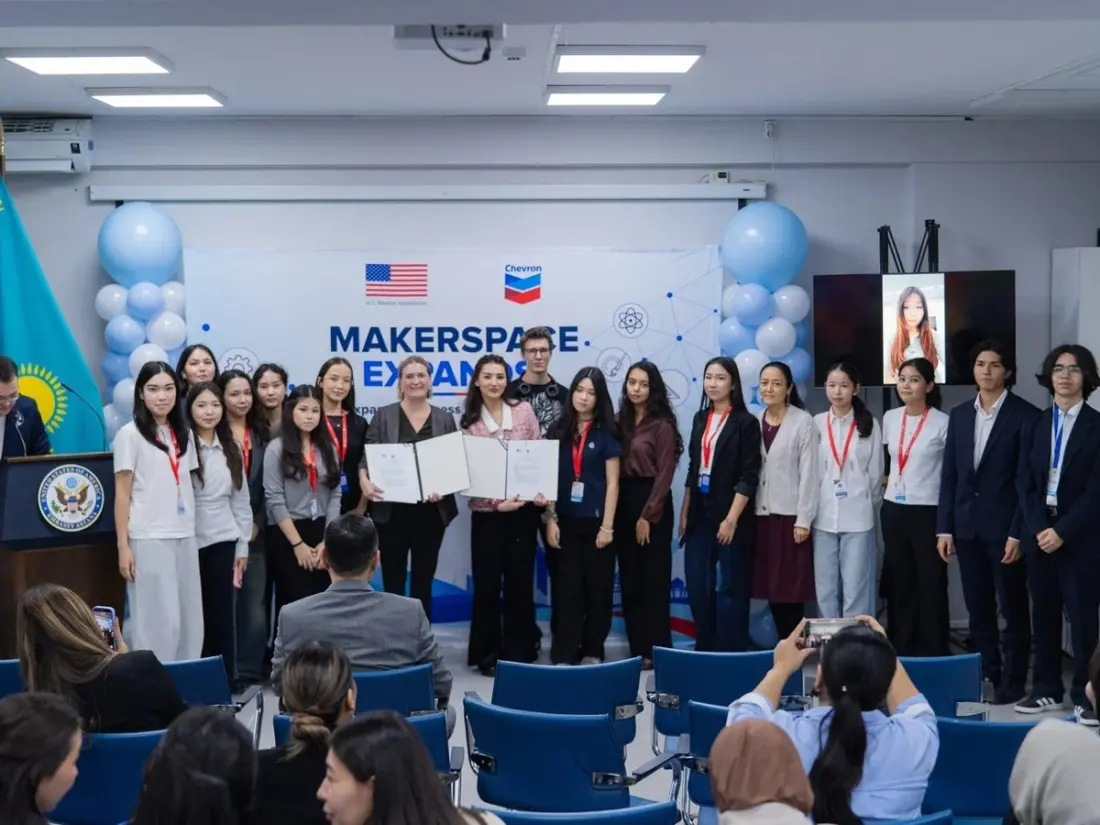
A quiet but significant education project is expanding in Kazakhstan. On November 5, the United States Embassy and Chevron signed an updated memorandum that extends their Makerspace programme for another three years — a network of free STEAM labs that has already reached more than 54,000 young Kazakhs since launching in 2020.
The idea is straightforward: hands-on learning in science, technology, engineering, arts and mathematics, delivered through laboratories housed at American Corners across the country. There are currently seven of them, spread between Astana, Almaty, Aktobe, Uralsk, Oskemen, Pavlodar and Petropavlovsk. Together they have hosted close to 2,300 workshops and training courses.
What happens inside? School and university students, plus young professionals, get free courses led by experienced instructors in robotics, artificial intelligence, 3D modelling, programming, rocketry and creative arts. US Ambassador Julie M. Stufft described the scene plainly: participants building robots, designing 3D models and exploring what the programme calls Super Intelligence. Chevron Eurasia President Derek Magness framed the renewal as a way to keep giving young people room to experiment and turn ideas into working projects.
For anyone travelling through Kazakhstan's larger cities, the American Corners themselves can be worth knowing about. They are public cultural and information spaces, typically offering libraries, English-language resources and community events — and in these seven cities, a glimpse of a very modern side of a country better known abroad for steppe, Silk Road history and oil wealth. Astana's futuristic architecture and Almaty's thriving café and tech scene make more sense once you see programmes like this feeding a young, ambitious workforce.
The programme's stated aim goes beyond hobbies: building critical thinking, teamwork and practical skills that feed into Kazakhstan's push for an innovation-driven economy. Whether the renewed partnership produces the 'next generation of talented Kazakh engineers and scholars', as the ambassador put it, remains to be seen — but three more years of free access to robotics labs and 3D printers is a concrete commitment, not just a press release.
For travellers, the takeaway is modest but real: if you're spending time in Almaty or Astana and fancy a free, local-flavoured event or an unusual stop off the tourist trail, check what the nearest American Corner has on its calendar. And if you're travelling with teenagers interested in tech, it's a rare example of a drop-in educational resource in Central Asia that costs nothing.