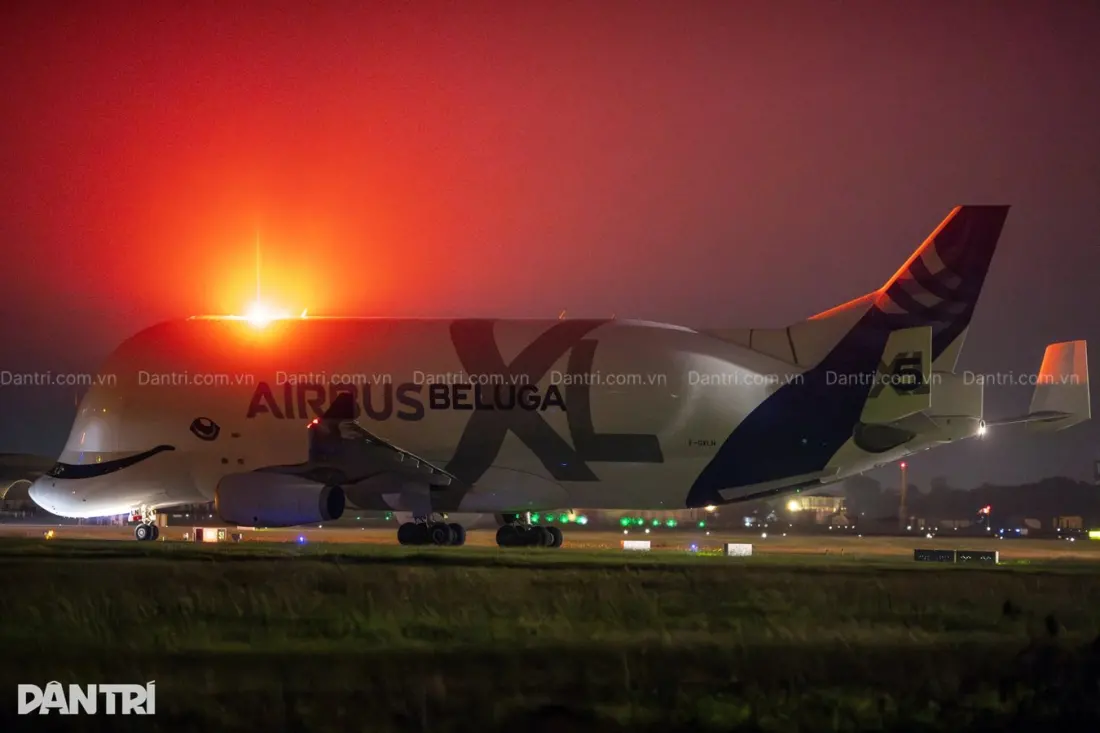
Da Nang's airport has hosted some remarkable aircraft over the years — including Air Force One and the jets carrying the Russian president. But when an Airbus Beluga rolled onto the tarmac, even seasoned local photographers admitted they'd never seen anything like it. The bulbous, whale-shaped cargo plane had touched down in Vietnam for the first time, drawing crowds to the perimeter fence and flooding local social media with photos within hours.
The visitor was an A300-600ST, the original first-generation Beluga, flying in empty from Kolkata, India, before continuing to Taiwan the same evening. It stayed only a few hours — Airbus never explained the routing — but its silhouette left an impression. Confusingly, some early reports called it a BelugaXL, the newer and larger successor, but its dimensions gave it away as the older ST. Notably, a sister aircraft later became the first Beluga to land in the Philippines too, arriving at Clark in July 2023.
The Beluga exists because of Airbus's unusual setup as a pan-European consortium. Wings are built in Britain, fuselages in Germany and France, tailfins in Spain — and all of it has to reach final assembly lines in Toulouse, Hamburg and elsewhere. After decades of relying on road transport and the older turboprop Super Guppy, Airbus took the job to the air. Engineers lopped off the top of a standard A300-600 fuselage and bolted on a huge bubble-shaped cargo hold with an upward-opening nose and a lowered cockpit. Only five were ever built, registering just under 47 tonnes of payload and moving everything from A350 wings to space station modules. Cargo highlights include the Columbus laboratory delivered to Kennedy Space Center in 2006 and, delightfully, Delacroix's painting Liberty Leading the People, flown from Paris to Tokyo in 1999.
Its story is now coming to an end. Airbus retired the type in favour of six BelugaXLs — bigger, smiling, and capable of carrying two complete A350 wings at once. The commercial charter operation for the old fleet shut down in early 2025, formal retirement began in January 2026, and the rest of the fleet will be withdrawn before 2027. One aircraft has landed at a museum in Toulouse; the youngest has become a STEM education centre at Hawarden Airport in North Wales.
For travellers, this is a niche-but-charming slice of aviation history: if you want to see a Beluga, the window on the originals is closing fast. The newer BelugaXLs still fly regular routes across Europe and are worth a look — or a photo — if one crosses your path. And for plane spotters, Da Nang has quietly earned its place on the map of airports that have hosted the world's strangest aircraft.