A writer for Intrepid's travel blog recently spent half a day in Osaka seeing precisely zero famous landmarks, and came away convinced it was the best way to know the city. His guide, Kazu from Intrepid Urban Adventures, runs a new tour called Retro Streets & Local Eats, which skips the standard sightseeing circuit entirely in favour of vintage shops, retro arcades, covered shopping streets and a lot of eating.
The premise makes sense once you accept that Osaka barely has a landmarks game to play. Aside from Osaka Castle, the Kaiyukan Aquarium and Universal Studios Japan, there are no big-ticket sights, and the city still ranks among Japan's most visited. What it does have is personality, food and history, and the tour threads all three together.
It starts with context: from the 60-storey Abeno Harukas observatory near Tennoji Station, Kazu explains that Osaka was briefly Japan's capital nearly 1,300 years ago, later grew rich as a trading port, and earned its nickname 'tenka no daidokoro' — the nation's kitchen — as the country's food supplier. Then it's down into Minami, the entertainment districts where locals actually unwind.
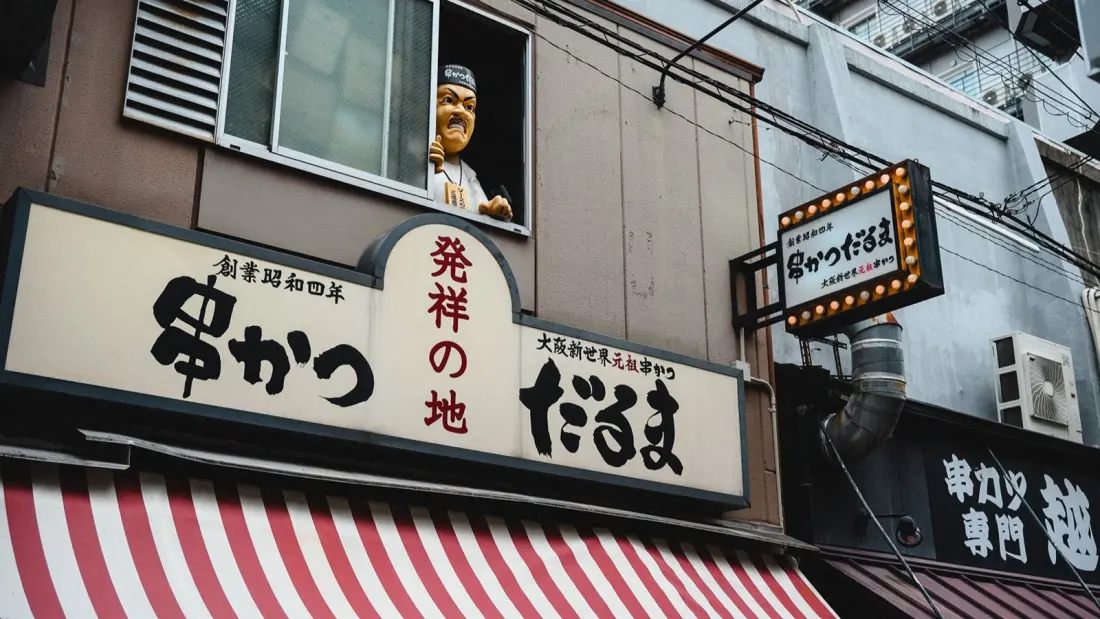
First stop is Shinsekai, a neighbourhood dreamed up in 1912 as a model district inspired by New York and Paris, which slid into post-war seedy red-light territory and has since cleaned up while keeping its nostalgic neon-and-lanterns atmosphere. Lunch here is kushikatsu at the original Kushikatsu Daruma, founded 97 years ago and guarded by a slightly terrifying plastic replica of its founder in the window. Kushikatsu — anything you like, deep-fried in panko — began as cheap fuel for day labourers, and the house rule is strict: never double-dip in the shared sauce. Use the side of cabbage instead.
From there the route runs through shotengai, the covered shopping streets that predate the shopping mall, some of them seemingly frozen in the late Showa era, with leopard-print blouses still on sale beside standing bars where retired salarymen have drunk for 40 years. Den Den Town, Osaka's answer to Akihabara, covers the otaku side: retro games, and Pokemon cards priced into four figures. Kuromon Market follows, and this is where the city's working-class soul shows — sashimi and premium fruit at local prices, no $200 omakase, and street snacks like spicy pickles, obanyaki stuffed with custard, and mixed juice made from overripe premium fruit so nothing goes to waste.
The tour wraps at the one concession to iconography: Dotonbori's neon riverside and the Glico Running Man sign, plus takoyaki at Honke Otako, chosen for its unusually generous octopus chunks. Warned: the inside is molten.
Why does this matter to travellers? Because Osaka rewards people who travel for atmosphere rather than attractions. If Kyoto is shrines and Tokyo is skyline, Osaka is conversation, fried food and neon, and a guide-led half-day is an efficient way in. It's also a good template for any city trip: eat where locals eat, browse where locals shop, and let the famous sights fend for themselves. Intrepid Urban Adventures