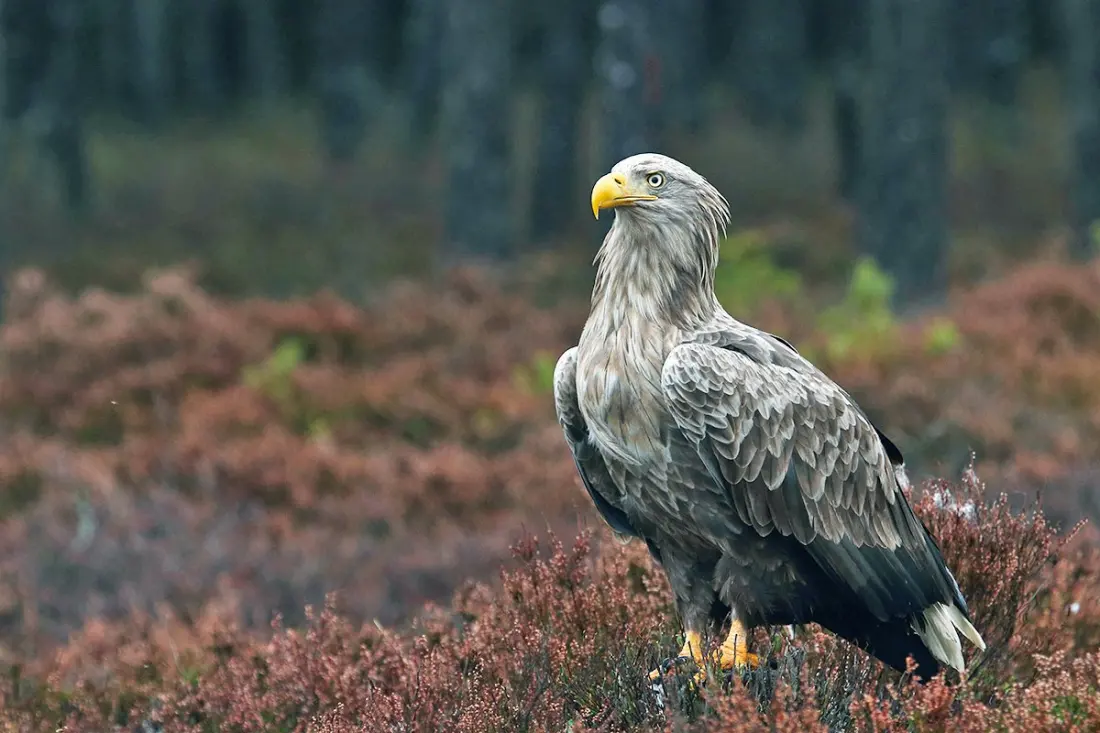
Half a century ago, spotting a white-tailed eagle in Estonia was close to impossible. Decades of hunting, poisoned bait and DDT-thinned eggshells had wiped out successful breeding entirely — by the 1960s, not a single nest produced chicks. Today the country holds roughly 290 to 330 breeding pairs, making this one of Europe's most underrated wildlife recovery stories.
The merikotkas, as Estonians call the sea eagle, is the country's largest bird of prey: up to 2.45 metres of wingspan, broad fingered wings and a short white tail. Nineteenth-century naturalists counted hundreds of pairs around Lake Peipus, but persecution nearly erased them. The turnaround came slowly — pesticide bans in the 1970s, nest guarding by volunteers, and the Estonian Eagle Club (founded 1999) monitoring eyries and running winter feeding. Across the wider Baltic, numbers climbed from about 670 pairs in the 1990s to around 3,000 by 2012.
The eagle's return is reshaping the ecosystem in visible ways. A 2025 study found its hunting grounds increasingly overlapping with great cormorants in the Baltic, with raids on colonies intensifying — on Hiiumaa, up to 26 eagles have been seen hitting a single colony at once, sometimes forcing the whole colony to move. Ecologists see this not as a problem but as a sign a top predator is doing its job again, and a marker of cleaner food chains and healthier wetlands.
For travellers, this translates into some of the most reliable eagle-watching in Europe. Matsalu National Park on the west coast is the stand-out spot, with regular sightings at Haeska, Keemu and Põgari, plus Haapsalu's Tagalaht Bay and the Silma Nature Reserve. In winter, when ice closes the shallow bays, eagles gather wherever water stays open. The islands of Saaremaa, Hiiumaa, Vormsi and Muhu — all reachable by ferry — hold the highest breeding densities; Hiiumaa alone supports at least 25 pairs. If you can't get there, the Estonian Eagle Club's live nest camera streams the drama year-round to viewers worldwide.
The recovery is still fragile. Forestry that removes the big mature trees eagles nest in is now the main threat, and nest sites remain legally protected. Visiting as a nature tourist is part of the solution — your ferry ticket to Hiiumaa helps keep a living argument for protecting old coastal woodland. Bring binoculars, dress for Baltic wind, and give yourself a couple of days: patient scanning from a coastal hide usually beats driving around hoping for luck.